
background preloader

4 Types of Parenting Styles

Facebook Twitter

Every parents have different ways of teaching their children. A parenting style is a psychological construct representing standard strategies that parents use in their child rearing.

Different parenting styles would have different effects on the children as it can affect their child's health, self-esteem, and overall well-being. These parenting styles fall into a generally accepted four broad categories. 4 Types of Parenting Styles and Their Effects on Kids. Your parenting style can affect everything from how much your child weighs to how she feels about herself. It's important to ensure your parenting style is supporting healthy growth and development because the way you interact with your child and how you discipline her will influence her for the rest of her life.

Researchers have identified four types of parenting styles:1 AuthoritarianAuthoritativePermissiveUninvolved Each style takes a different approach to raising children and can be identified by a number of different characteristics. Authoritarian Parenting Do any of these statements sound like you? You believe kids should be seen and not heard.When it comes to rules, you believe it's "my way or the highway. " If any of those ring true, you might be an authoritarian parent. Authoritarian parents are famous for saying, "Because I said so," when a child questions the reasons behind a rule. They also don't allow kids to get involved in problem-solving challenges or obstacles. The Definition of Authoritarian Parenting. Authoritarian parenting is a parenting style characterized by high demands and low responsiveness. Parents with an authoritarian style have very high expectations of their children, yet provide very little in the way of feedback and nurturing.
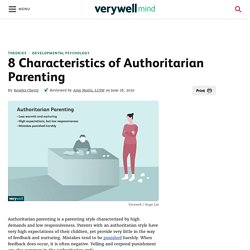
Mistakes tend to be punished harshly. When feedback does occur, it is often negative. Yelling and corporal punishment are also common in the authoritarian style. During the 1960s, developmental psychologist Diana Baumrind described three different types of parenting styles based on her research with preschool-age children. Authoritarian parents have high expectations of their children and have very strict rules that they expect to be followed unconditionally. People with this parenting style often use punishment rather than discipline. Characteristics of Authoritarian Parents Baumrind believed that one of the major roles that parents play in a child's life is to socialize them to the values and expectations of their culture.

Mistrusting Shaming. Authoritarian Parenting (Tough Love Parenting) - ParentingForBrain. 3c4475adb3b9462c149a8d4d580ee7e85644. Effects. What Is Authoritative Parenting? [With Examples] - ParentingForBrain. What Is Authoritative Parenting? Authoritative parenting is characterized by reasonable demands and high responsiveness. While authoritative parents might have high expectations for their children, they also give their kids the resources and support they need to succeed. Parents who exhibit this style listen to their kids and provide love and warmth in addition to limits and fair discipline. This approach to parenting avoids punishment and threats and instead relies on strategies such as positive reinforcement. Brief History During the 1960s, developmental psychologist Diana Baumrind described three different types of parenting styles: authoritarian, authoritative, and permissive.
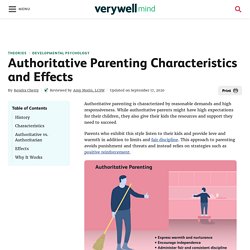
The authoritative parenting style is sometimes referred to as "democratic. " Traditionally, the authoritative parenting style has been identified as the most effective and helpful to a child; research suggests that parents should flexibly deploy parenting techniques based on their personal goals and the unique behaviors of each child.2 Effects. Baumrind. Effects. What Is Permissive Parenting? Permissive parenting is a type of parenting style characterized by low demands with high responsiveness. Permissive parents tend to be very loving, yet provide few guidelines and rules.
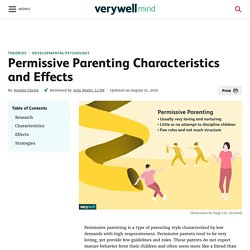
These parents do not expect mature behavior from their children and often seem more like a friend than a parental figure. These parents tend to be the polar opposite of the so-called "helicopter parents. " Instead of hovering over their children's every move, permissive parents are incredibly lax and rarely make or enforce any type of rules or structure.

Their motto is often simply that "kids will be kids. " While they are usually warm and loving, they make little or no attempt to control or discipline their kids. Because there are few rules, expectations, and demands, children raised by permissive parents tend to struggle with self-regulation and self-control. Early Research on Permissive Parenting Permissive parenting is sometimes known as indulgent parenting. Characteristics of Permissive Parenting. Permissive Parenting - Why Indulgent Parenting Is Bad For Your Child - ParentingForBrain. The permissive parenting style: Does it ever benefit kids? © 2019 Gwen Dewar, Ph.D., all rights reserved Some studies have linked the permissive parenting style with optimal child outcomes. But the results depend on how researchers define "permissive.
" Kids don't benefit when parents ignore anti-social behavior. But being supportive of autonomy? That's different. Permissive parents are warm and responsive, and that's a good thing. But when it comes to another factor -- setting limits -- permissive parenting is often portrayed as second-best. Authoritative parenting has a lot in common with permissive parenting.

But unlike permissive parents, authoritative parents are relatively demanding. There are studies to back this up -- particularly among families in the United States. Another study -- focusing on American children under the age of 8 -- found that permissive parents were more likely to have kids showing deficits in self-control (Piotrowski et al 2013).

But there is conflicting evidence. But were the parents authoritative or permissive? Effects. Characteristics and Effects of Uninvolved Parenting. Uninvolved parenting, sometimes referred to as neglectful parenting, is a style characterized by a lack of responsiveness to a child's needs. Uninvolved parents make few to no demands of their children and they are often indifferent, dismissive, or even completely neglectful. The Major Parenting Styles During the 1960s, psychologist Diana Baumrind described three different parenting styles based on her research with preschool-age children: authoritarian, authoritative, and permissive parenting. In later years, researchers added a fourth style known as uninvolved parenting.
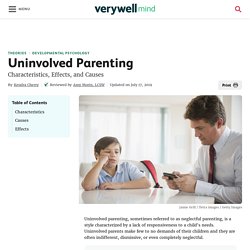
So what does the uninvolved parenting style look like at a glance? Some uninvolved parents may be relatively hands-off with their kids, but may still have some basic limits such as curfews. Characteristics of Uninvolved Parenting Styles In order to better understand what uninvolved parenting consists of, it can be helpful to look at some of the key characteristics of this parenting style. Causes of Uninvolved Parenting. The Risks Of Having An Uninvolved Parenting Style | Regain. Updated July 13, 2019 Do you know what type of parenting style you have, or what type your parents had? Knowing what parenting style(s) a child was raised with can tell you a lot about their behavior as they age, and even when they start raising their kids.
Parenting style can affect many things, like a kid's self-esteem, behavior, and even their mental health. Some parenting styles are known to lead to better outcomes for kids than others. Source: pxhere.com Overview Of The Four Main Parenting Styles Four main parenting styles are recognized in psychology today, each with differing levels of parent responsiveness and demandingness: Authoritative - Commonly viewed as the most effective parenting style. By classifying and studying these different parenting styles, researchers have been able to track the effects of parenting on children over the long term. Source: maxpixel.freegreatpicture.com It's true that each parenting style, like most things, has its pros and cons. Why is this important?

The Long-Term Impact of Neglectful Parents. Source: JPagetRFPhotos/Shutterstock If you were emotionally or physically neglected as a child, it can be a difficult journey to healing. Neglect can be a hard thing to put your finger on, especially emotional neglect. Neglected children often don’t realize they are being neglected at the time, and can internalize the pain and loneliness and think it is their fault. They are often told they are “too sensitive” or “selfish” if they try to get their needs met. Parents with little empathy often neglect their children and don’t even realize it, while there are also parents who don’t care.
Either way, the child grows up wondering about their own self-worth and value. article continues after advertisement Traumatic experiences like abuse and neglect have an adverse effect on children’s brain development. Young children naturally have a playful and curious spirit about them. We’ve all had the experience of seeing children mistreated in public. Effects. Parenting styles chart. Conclusion.