10 Telling Studies Done on Longer School Days. With test scores faltering in many school districts and American students lagging behind their counterparts in other countries around the world, education reform has become a hot topic of late. One of the ways many school districts are looking to improve their grades and test scores is by lengthening the school day, with the idea that more time at school means more time that teachers can work with and educate students. While longer school days may work for some students and districts as a whole, research on the issue is divided. Some studies have found little to no benefit to extending the school day, at least not without making serious other changes to the school’s curriculum as well. Others take a more positive view. One study showed that longer school days resulted in a big jump in test scores.
Extended school days are most effective when the added time is carefully structured and planned. 11 Surprising Factors That Determine Your Success in School. 10 New Trends in Outsourced Grading. Amid complaints of grade inflation and uneven evaluation, many schools have sought to find new ways to grade students. One of the more recent and perhaps most controversial is through outsourcing grading. While not widespread yet, a growing number of universities (including some online universities) are becoming more and more willing to try out this new trend in grading, sometimes hiring their own professional graders or an outside company that specializes in student evaluation.
Reactions from faculty and students alike have been mixed, but many believe these external graders are more fair, consistent, and reliable than overburdened teaching assistants and professors. If you’d like to learn a bit more about how outsourced grading is being used today and where it might be going in the future, read on, as we’ve collected information about some of the biggest trends affecting this new academic industry that may soon be coming to a college near you. 10 Novels That Nail the College Experience.
11 Most Unhelpful Self-Help Books. There are some things you just shouldn't teach yourself from a book: open-heart surgery, how to kiss, ways to become less shy. Reading up on these skills wouldn't help you learn and would probably just be embarrassing or dangerous. Self-help books make some readers feel like they can learn to do anything, from fixing their cars to changing their lives, and while there might be dozens of books that really provide useful information, many just aren't helpful. Check out what not to buy before you head to the bookstore to improve yourself. Winning Lotto/Lottery for Everyday Players by Professor Jones There are several disturbing aspects of this book.
First, it's for the type of human who will not only throw away money on lottery tickets, but also shell out cash for a book on how to win the lottery rather than on making money through hard work. 10 Books on China Every MBA Student Should Read. The 10 Best Protest Books of All Time. 10 Impressive People Who Educated Themselves With Only a Library Card - Online College Courses | Online College Courses. While formal schooling from kindergarten all the way up to the college level has a lot to offer a knowledge-thirsty mind, the reality is that you don’t necessarily have to go to school in order to learn and be well-educated. The vast majority of information (especially in today’s world) is free to access at your local library at your own leisure, and many have done just that to keep learning even when they couldn’t or didn’t want to go to school.
Whether they read their way to education at a public library or in their own homes, there have been been some pretty well-known names who have used books to expand their minds. Many have gone on to be writers, political leaders, and businesspeople, and while you might not know every name on this list, their stories will certainly convince you that a library card in the hands of a determined learner is a very powerful thing indeed. 20 Amazing Examples of Legos in the Classroom. It doesn't matter if you're four or 40, when you see Legos they are nearly impossible to resist putting together, pulling apart, and building into something.
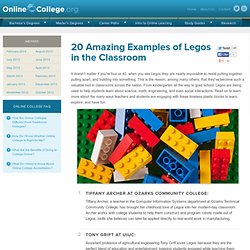
This is the reason, among many others, that they've become such a valuable tool in classrooms across the nation. From kindergarten all the way to grad school, Legos are being used to help students learn about science, math, engineering, and even social interactions. Read on to learn more about the many ways teachers and students are engaging with these timeless plastic blocks to learn, explore, and have fun. Tiffany Archer at Ozarks Community College: Tiffany Archer, a teacher in the Computer Information Systems department at Ozarks Technical Community College, has brought her childhood love of Legos into her modern-day classroom. North Star Academy: Students at North Star Academy use Legos to build robots, but not just any robots. The students create robots to solve a particular problem. Finance Blog | MoneyHacker How Students can Stay Debt Free in College. Taking out loans in order to complete your college degree sets you up for years of repayment.
Not only that but having student debt can also make it difficult to finance major purchases, such as a car, after graduation and may force you to take a more stressful job just for the higher salary. Thus, staying out of debt while in college will afford you greater freedom after graduation. Choose Wisely When applying for colleges, do your research on the cost of tuition, room and board and other required fees such as laboratory and supply fees. Although having a job while in school puts constraints on your time, it teaches you the value of hard work and gives you experience that will look great on your resume upon graduation. Educate Yourself Ideally, before you go to college, you will already understand how to balance a checkbook, pay a bill, calculate simple and compound interest and prioritize needs versus wants.
Prioritize Avoid Credit Cards Resist Temptation Student Discounts. Onions, Cabbage... & Antibiotics | VINE Sanctuary Blog. By bravebird, on May 14th, 2009 Everybody knows by now, we hope, that most antibiotics are fed to farmed animals, that the antibiotics excreted by those animals end up in our water (not to mention the meat, eggs, and milk consumed by non-vegans), and that this is the primary reason for the emergence of antibiotic-resistant “super-bugs.”
Now there’s a new reason to worry: Antibiotics have been found in vegetables grown in fields fertilized with manure — including organic vegetables. Here’s how it works: 70% of antibiotics used in the United States are fed to farmed animals in order to promote rapid growth and mitigate the spread of disease in crowded factory farms. Animals excrete about 90% of the antibiotics fed to them. Farmers dump manure on fields as a cheap way to replace the nitrogen taken up by crops. And — now we know — the plants grown in those fields take up trace amounts of the antibiotics along with the water and nutrients they draw from the soil. Organic crops are no safer. { Kaileen Elise } Make Every Day Extraordinary » Blog Archive » Nutritious Guest Post – Analiese from Green Plate Studios. Live with intention. Walk to the edge. Listen hard. Practice wellness. Play with abandon. Laugh.
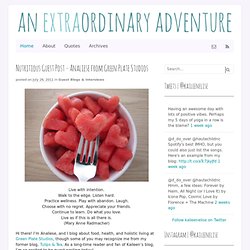
Hi there! A couple years ago, frustrated with my lack of energy and general feelings of blah-ness, I embarked on an effort to transform my health. It can be difficult, especially as a woman, to prioritize our own wants and needs. Sounds great, you might be thinking. Here are the 4 elements of self-care that I’ve experienced as absolutely essential in my path toward wellness: 1. Clean, unprocessed foods boost energy levels and provide you with the nutrients you need to look and feel your best. Have fun with food by experimenting with new recipes, and remember that a meal doesn’t need to be complicated to be good. 2. When it comes to movement, a world of delicious, heart-pumping adventure awaits. 3. I believe that true wellness is so much broader than simply fulfilling the needs of the physical body. 4.
I hope these thoughts inspire you to begin (or continue) your own wellness journey! 11 Tech Companies Investing in Education. When we think about big corporations, even cool techie ones, we're often quick to point out all the things they do wrong, from sketchy environmental records to snarky CEOs. Yet many corporations spend a great deal of time and money giving back to the community; it's not always just for the good PR.
In many cases, these companies are actually pretty passionate about their causes and many may actually be the driving force behind changing hundreds of young lives for the better. At this time of year, when charitable giving is on many people's minds, it can be useful to take a look at the ways that some of the biggest tech companies in the U.S. and the world are giving back and investing in education. Many have programs and initiatives you've never heard about and spend millions of dollars each year helping to expand the minds and the opportunities available to the next generation of potential tech-whizzes, scientists, and writers.
Early Childhood Education Blog | ChildMark. Really? Well, two programs show strong evidence that it does. One study showed that children that did not participate in an early childhood program in Chicago were, by age 18, more than 70 percent more likely to have been arrested for a violent crime. Researchers estimate that the program will have prevented 33,000 crimes by the time children reach age 18.
By age 24, they were 24 percent more likely to have been jailed than participants. Doing quality formative activities with your children will have a lifelong affect on them. 50 Teachers Who Are Social Media Stars | Best Colleges Online. Social media is playing a bigger role in education than ever before. From being used in elementary, secondary, and college classrooms across the nation to helping instructors keep in touch, share ideas, and learn new and innovative strategies for teaching, social media is a must for those starting out or staying current with a career in education.
Some teachers, however, are ahead of the curve, and have made a name for themselves sharing their expertise through sites like Twitter and Facebook and their own blogs. Here, we’ve highlighted just a few of the amazing teachers, educators, and professors who are taking social media by storm. From elementary to special education to high school, these teachers are sharing their resources and tech-savvy through social media.
Vicki Davis If you follow education blogs online, chances are pretty good that you’ve come across this award-winning teacher’s work. Her blog is incredibly popular, and she has over 27,000 followers on Twitter. 10 Kid Rappers Who Put The Big Boys to Shame. Like every other genre of music over the past couple of decades, rap has been homogenized by the big record companies, which are most concerned about producing music that'll be accepted by a mass audience. While artists have become less creative and more concerned with creating an image, some young — in some cases, very young — aspiring rappers have honed their skills, outdoing their older counterparts.
Here are 10 who have received tens of thousands and even millions of hits on YouTube, as they've taken advantage of people's affinity for young performers. P-Nut, seven years oldThe typical daily activities of a four-year-old may include watching Bubble Guppies or throwing an uproarious temper tantrum in the grocery store because mom refused to buy him or her a toy. But P-Nut was different. While his dad was teaching him to add and subtract by rhyming, he became a student of hip hop.
By the age of seven, he was being featured in local news programs and popular YouTube videos. 9 Greatest Inventions for the Physically Impaired. Braille For those of us blessed with sight, those strange little bumps we see on signs are totally foreign to us, but for blind people, Braille is a way of learning, being independent, and staying safe. Braille is a system that allows those without sight to read using their fingertips by assigning patterns of raised dots to each character in the alphabet and other symbols.
Before the invention of Braille, books for the blind were made by embossing traditional letters, but they were time-consuming to produce and hard to read at a normal pace. Lessons were learned verbally, passed down from older students or tutors. A blind Frenchman named Louis Braille developed the idea, building on a rejected idea for a military code, and the system was put into practice in 1825. This invention may not be life-changing for a visually impaired person, but it allows him or her to live as any other person would and "see" parts of their surroundings. 15 Flipped Classrooms We Can Learn From.