
Solar Fencing. For more than a decade, Jiyalal’s four bighas of cultivable land in Tarapur Naya Gaon village in the Mashobra block of Shimla district, Himachal Pradesh, had been rendered barren.
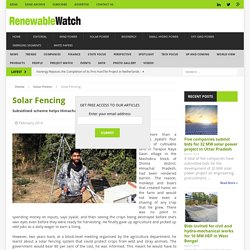
The reason, monkeys and boars that created havoc on the farm and would not leave even a shaving of any crop that he grew. There was no point in spending money on inputs, says Jiyalal, and then seeing the crops being destroyed before one’s own eyes even before they were ready for harvesting. He finally gave up agriculture and picked up odd jobs as a daily wager to earn a living. However, two years back, at a block-level meeting organised by the agriculture department, he learnt about a solar fencing system that could protect crops from wild and stray animals. The government would bear 80 per cent of the cost, he was informed. Dharamdutt from Bhajyar, Shimla district, could save his maize crop from monkeys with solar fencing. Jiyalal and Dharamdutt are not the only ones.
Waste Woes. Around 500 GW of solar panels have been installed worldwide.
In India itself, the installed solar capacity has crossed 25 GW and the country is expected to add over 11 GW over the next few years. However, solar panels are beneficial for the environment only during their operational period. The disposal of panels presents a major challenge once their useful life is over. The Photovoltaic Power Systems Programme of the International Energy Agency (IEA-PVPS), in its 2016 study on end-of-life management of solar PV panels, estimated the cumulative global PV panel waste volume to reach 60-78 million tonnes by 2050, with an annual waste generation of 5.5-6 million tonnes in the 2050s.
The actual waste volumes are expected to be much larger mainly because the Chinese and Indian markets have grown faster than expected by the IEA-PVPS study. CleanMax Solar. Most states in India have significantly higher tariffs for commercial and industrial (C&I) consumers as compared to residential and public sector consumers.
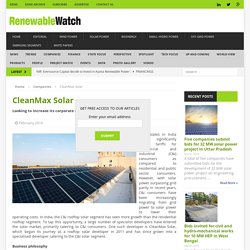
However, with solar power surpassing grid parity in recent years, C&I consumers have been increasingly migrating from grid power to solar power to lower their operating costs. In India, the C&I rooftop solar segment has seen more growth than the residential rooftop segment. To tap this opportunity, a large number of specialist developers have entered the solar market, primarily catering to C&I consumers. One such developer is CleanMax Solar, which began its journey as a rooftop solar developer in 2011 and has since grown into a specialised developer catering to the C&I solar segment. Business philosophy. A Better Mix. The small hilly state of Uttarakhand was formed just two decades back on the premise that abundant hydropower and increasing tourism would make the state profitable.
Nearly two decades later, it is safe to say that the state has been largely successful in leveraging this potential. Uttarakhand records one of the largest tourist numbers in India in a year. While this brings revenue for the state, it also increases the state’s power demand. Uttarakhand has a high hydro potential, estimated at 20 GW, which complements the increasing power demand in the state. Policy Revision. Growing Acceptance. Ground Realities. In what can be termed as the first significant move towards resolving the issue of land constraints for renewable energy project development, the Government of Gujarat has released its land policy for such projects.
The new policy mandates that all future solar, wind and solar-wind hybrid projects will have to be built in parks allocated for such systems. Gujarat, which is home to several solar parks, intends to avoid scattered project development across the state and make evacuation feasible and convenient. According to the new policy, an area that can host 30 GW of renewable energy generation capacity will be sanctioned for parks, each park large enough to house a minimum of 1 GW of capacity. Of the 30 GW, a third would be set aside for projects initiated by state PSUs. In 2018, SECI auctioned 4.5 GW of wind power projects under Tranche III (March), Tranche IV (June) and Tranche V (September), wherein developers had the option to set up plants anywhere in the country. Yoma Micro Power. In stark contrast to the developed nations where reliable power supply is available to all, access to electricity is still a challenge faced by the rural communities in most developing nations.
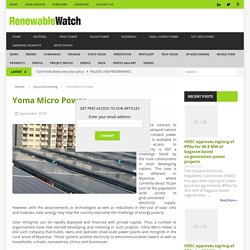
The case is no different in Myanmar, where currently about 70 per cent of the population lacks access to grid-connected electricity supply. However, with the advancements in technologies as well as reductions in the cost of solar cells and modules, solar energy may help the country overcome the challenge of energy poverty. Solar minigrids can be rapidly deployed and financed with private capital. Thus, a number of organisations have now started developing and investing in such projects. NLC India. While the private sector has played a significant role in promoting renewable energy in India, the public sector too is emerging as a growth driver with more public sector units (PSUs) looking at alternative sources of power generation to become diversified energy companies.
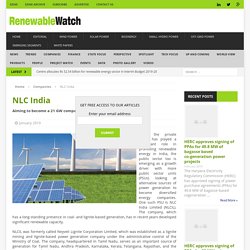
One such PSU is NLC India Limited (NLCIL). The company, which has a long-standing presence in coal- and lignite-based generation, has in recent years developed significant renewable capacity. NLCIL was formerly called Neyveli Lignite Corporation Limited, which was established as a lignite mining and lignite-based power generation company under the administrative control of the Ministry of Coal. The company, headquartered in Tamil Nadu, serves as an important source of generation for Tamil Nadu, Andhra Pradesh, Karnataka, Kerala, Telangana, Rajasthan, and the Union Territory of Puducherry.
Today, the company’s installed capacity has crossed 4.8 GW. Up and Coming. QBots Setting up rooftop solar for residential and commercial consumers has been a challenge worldwide due to its high cost and the intermittency of the energy source in itself.
While the costs have come down and net metering options enable faster returns on investments, incorporating energy storage to ensure power reliability is still quite expensive. As the industry is looking at technology innovation to cut down costs further, new business models are coming up that combine energy generation and consumption with artificial intelligence (AI) and internet of things (IoT) to optimise the value chain and increase revenues. QBots is one such company that deploys AI to build and operate a virtual or federated power plant (FPP). Up and Coming. Up and Coming - Solar bubble dryer for agricultural crops. Recently, the International Rice Research Institute (IRRI), Philippines, demonstrated a crop drying technology in Odisha.
The solar bubble dryer (SBD) technology, jointly developed by GrainPro, a leading post-harvest solution providing company, IRRI and the University of Hohenheim, Germany, has been showcased for the first time in India. Finding Solutions. By Ashay Abbhi India’s renewable energy sector witnessed a flurry of policy and regulatory activity during 2018.
While the outcomes of the regulatory developments of the previous year began to emerge this year, new regulations were also introduced to put the sector on a target-based growth trajectory. Several policies were released for renewable energy generation, transmission, distribution and storage during the year. These are expected to set the stage for the achievement of the 175 GW of installed capacity target by 2022. The policy changes are aimed at tackling the various pain points in the renewable energy sector in a bid to increase operational and regulatory efficiency.
Amendments to Electricity Act. CEL invites RfS bids for 11.12 MW grid-connected rooftop solar PV projects. Making Business Sense. While solar power has crossed grid parity globally, commercial and industrial (C&I) consumers in India continue to pay substantially higher grid tariffs to discoms than domestic consumers. In order to reduce their operating expenses, C&I consumers are now procuring significant solar power through onsite rooftop solar plants and offsite solar plants.
Industry experts share their views on the key developments, challenges and emerging business models in the C&I solar segment in India. Excerpts… Cleaning Up Landfills. First 5MW SKY Project—Contributed by TATA Power & GoodWe. Malaysian 49 MW Solar Power Plant Connected to the Grid. Quality Concerns. By Ashay Abbhi Considering that the life cycle of a solar power plant spans about a quarter of a century, durability and consistency of solar panels become extremely important.
The quality of panels and all other components directly impacts the cost of energy, revenues and returns on investment for project developers and operators. Quality control, therefore, assumes paramount importance to generate the best yields from a solar power plant. While there is a move towards the adoption of new technologies, inadequate quality standards for these technologies make critical decision-making difficult.
Seeking Sustainability. By Ashay Abbhi The dynamics of financing renewable energy projects in India have evolved as the sector is undergoing a paradigm shift. Deemed to already be a challenge, access to competitive finance for projects has become an even bigger hurdle as profit margins diminish and the payback periods increase. In fact, sensing the increasing reluctance of lenders to invest in renewable energy projects in India, R.K. Singh, minister of new and renewable energy, had to call a meeting of all stakeholders in September 2018 to address the pressing concerns such as operational risks regarding renegotiation of power purchase agreements (PPAs), threat of backing-down of power, removal of must-run status, and low tariffs.
Meanwhile, the market is abuzz with conversations around getting a better foothold on the financing of projects while protecting the interests of financiers and lenders to create long-term sustainable assets. Mergers and acquisitions Debt deals IPOs. Second Wind. Wind power development started in India in the mid-1990s, nearly twenty-five years ago. Since then, the country has seen rapid growth in this segment. It currently has about 35 GW of installed capacity and ranks fourth in global wind capacity installations. According to estimates, many of these projects are located in high-wind sites, with wind turbine generators (WTGs) of capacities lower than 500 kW and hub heights of not more than 30 metres. Hence, the energy generation at these wind farms is much lower than that possible at the same sites using modern higher capacity turbines. The process of replacing older wind turbines with newer ones that have a higher rated power capacity and greater efficiency – thus leading to higher generation – is called repowering.
Case for repowering The standard commercially available WTGs at present have a capacity rating of 2 MW to 3 MW, with hub heights going beyond 100 metres. Bringing in Reform. Honduras, with a per capita GDP of $2,480 in 2017, is the second poorest country in Central America and the third poorest in Latin America, ahead of only Haiti and Nicaragua. The country, however, has ample natural resources to achieve energy self-sufficiency. It has significant solar energy potential owing to its geographic location, as well as an estimated hydroelectric potential of 5,000 MW.
Optimising Costs. Sunny Isles. Slow but Promising. The rooftop solar segment has been slow to take off. EV Plus PV. Global automakers are going all-out on vehicle electrification, with planned spends of $300 billion over the next decade, according to latest industry reports. The world’s largest automaker by sales, Volkswagen alone has announced plans to invest $34 billion on e-mobility initiatives and $57 billion on battery procurement.
Alongside, massive plans have been drawn up by governments across the world to facilitate the setting up of supporting charging infrastructure. This rush towards e-mobility comes as environmental and climate regulations have tightened around the world, and technological improvements have made electric vehicles (EVs) cheaper than ever. Fresh Initiatives. Avaada Power. UPNEDA invites RfP bids for 500 MW grid-connected solar PV power project in Uttar Pradesh. APGCL invites RfP bids for 70 MW solar PV power project in Amguri, Assam. UJVN invites bids for development of three small hydro electric projects in Uttarakhand. WBREDA invites bids for 11 MW grid-connected rooftop solar PV power projects. MSPGCL invites RfS bids for wind solar hybrid project in Maharashtra.
Rewind 2018. Competitive Pressures. 2,000 MW of ISTS-connected wind power projects face roadblocks. The 2,000 MW ISTS-connected wind power projects (Tranche IV) are facing roadblocks in their implementation due to land acquisition issues. Sun, Straw and Small-hydro. Soiling Analysis. Case for Hydro. Paddy Power. Decentralised Energy. Thinking O&M. Dear Money. Bigger and Better. Offshore Wind Plans. Energy Transition. Clean Power Ties. Towards Decarbonisation. Wind Rich. Energy Union. Renewables Action Plan. Global Scenario. Rehal Case Study. Right to Light. Reusing Residue. Lukewarm Response. Promoting Biofuels. Waste Value.
From Biogas to Bio-CNG. Dumpyard to Power Plant. Utilising Waste. A Way Out. Rooftop Solar Goals. Sun Lit. Solar EPC Trends. Fresh Fillip. Solar Schedule. Solarising Dwarka. Quality in Question. IBC SOLAR Energy. Tough Target. Creating Ripples. Performance Edge. Two Good. Towards a Green Tomorrow. Risk Assessment. Wind Woes. Bridging the Gap. Early Mover. Infrastructure Revamp - Renewable Watch. Setting a Trend - Renewable Watch. Green Outlook - Renewable Watch. Creating Synergies - Renewable Watch. Wind Rich - Renewable Watch. Mapping Potential - Renewable Watch. Emerging Opportunities - Renewable Watch. Reducing Risks - Renewable Watch. Feeling the Pressure - Renewable Watch. Achieving 60 GW - Renewable Watch. CLP India - Renewable Watch. Renewable Energy News Magazine.