
Purpose, Audience and Tone. Purpose, Audience, Form (P.A.F) Writing With Your Audience in Mind. Formal vs Informal Writing: What's the Difference and When to Use Them. Style, Diction, Tone, and Voice - Wheaton College, IL. Style Style is the way in which something is written, as opposed to the meaning of what is written.
In writing, however, the two are very closely linked. As the package for the meaning of the text, style influences the reader’s impression of the information itself. Style includes diction and tone. The main goal in considering style is to present your information in a manner appropriate for both the audience and the purpose of the writing. Diction Diction is word choice. Examples: Besides the level of formality, also consider positive or negative connotations of the words chosen.
Some types of diction are almost never advisable in writing. Tone Aside from individual word choice, the overall tone, or attitude, of a piece of writing should be appropriate to the audience and purpose. One way to achieve proper tone is to imagine a situation in which to say the words being written. In all of these cases, there is some freedom of self-expression while adapting to the audience.
Academic Writing Style - Organizing Academic Research Papers - Research Guides at Sacred Heart University. I.
The Big Picture Unlike fiction or journalistic writing, the overall structure of academic writing is formal and logical. It must be cohensive and possess a logical flow of ideas, which means that the various parts are connected to form a unified whole. There should be links between sentences and paragraphs so the reader is able to follow your argument. II. The Tone Throughout your paper, it is important that you present the arguments of others fairly and with an appropriate tone. Eapfoundation. Academic Style. Language, Tone and Audience. Tip_formal_writing_voice. Have you ever attended an event in which "formal" attire is expected?
You probably did not wear old jeans with holes in the knees, a stained tee shirt promoting your favorite beverage, and a pair of sandals. You probably chose more formal attire. If you were giving an important speech to a group of people you do not know, would you use the same kind of language you use when talking with friends? Probably not. Recognizing your lack of familiarity with the audience, the importance of the occasion, your desire to demonstrate your knowledge of the subject, and the impression you would like to make, you would probably use a more formal voice for your speech than what you would use when talking with close friends.
For all of the essays you write for this course, you should use a formal writing voice. The following guidelines should help you maintain a formal writing voice in your essays. 1. Example I think that this character is confused. Example I can sense the character's confusion. 2. EFFECTIVE USE OF LANGUAGE. The Importance of Language As a writer, it is important not only to think about what you say, but how you say it.
To communicate effectively, it is not enough to have well organized ideas expressed in complete and coherent sentences and paragraphs. One must also think about the style, tone and clarity of his/her writing, and adapt these elements to the reading audience. Again, analyzing one's audience and purpose is the key to writing effectiveness. Adapting to Your Audience - The WAC Clearinghouse. When we talk to someone face-to-face, we know just who we are talking to.
We automatically adjust our speech to be sure we are communicating our message. Many writers don't make those same adjustments when they write to different audiences, usually because they don't take the time to think about who will be reading what they write. To be sure that we communicate clearly in writing, we need to adjust our message--how we say to and what information we include--by recognizing that different readers can best understand different messages. Audience Definition An audience is a group of readers who reads a particular piece of writing.
Types of Audiences Audiences come in all shapes and sizes. Note: Your audience can be a combination of the two. Academic Style: key features in academic writing style. NO Idiomatic / colloquial (slang) Kids / boss / gonna / stuff NO Phrasal verbs Go up / look up NO Personal Pronouns I, we, In my opinion (limit use) NO Contractions It’ll = it will / It’s = it is NO Questions So why did the project fail?
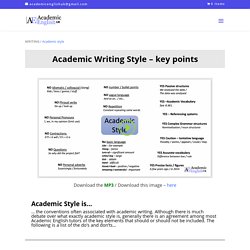
NO Personal adverbs Surprisingly / fortunately NO Repetition Constant repeating same words NO vague language And so on.. / etc… Paragraph Basics. How to write a paragraph. Identifying the topic/ ideas, coherence&unity in paragraph. Text Structures. 4 Understanding Text Structures (2)