
How Mobile Apps Drive Change in Taxi Industry? Five handy apps for booking a ride. As someone who travels almost constantly, I find myself routinely needing taxis or limos in unfamiliar cities.

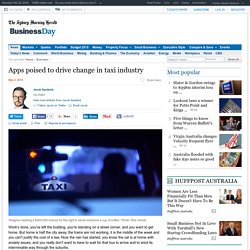
Thankfully, there are quite a few smartphone apps that can be used to arrange for ground transportation. This article lists five such apps. Before we get started, I want to pass along one bit of advice: It's a good idea to check the geographic service area prior to downloading an app. Apps poised to drive change in taxi industry. 'Imagine needing a $400,000 licence for the right to serve someone a cup of coffee.' Photo: Rob Homer Work's done, you've left the building, you're standing on a street corner, and you want to get home.
But home is half the city away, the trains are not working, it is the middle of the week and you can't justify the cost of a taxi. Now the rain has started, you know the cat is at home with anxiety issues, and you really don't want to have to wait for that bus to arrive and to wind its interminable way through the suburbs. The future of taxi-hailing apps. Over the past two months, two major taxi-hailing apps received new rounds of funding – in December, Baidu announced an investment in Uber while SoftBank, Alibaba Group and Tiger Global committed US$600 million to KuaiDi Dache.

However, the growth of such apps face many hurdles. Firstly, legal concerns. China’s Ministry of Transport also announced bans on taxi-hailing apps for private cars without taxi licenses last month, which would theoretically place limits on the growth of taxi-hailing apps. While Uber has been pushing for legislation in some US states to identify them as “transportation network companies” that can operate under certain sets of rules, legislation in other parts of the world may not been passed.
For example, taxi-hailing apps like Uber are seen as illegal by Spain, Canada and Thailand. What happens when app-makers work with the taxi industry, not against it. This process could get a lot more efficient — and it would help the taxi industry survive.

(Victor J. Blue/Bloomberg) Over the past few years, the most disruptive innovation in transportation has been sharing: Smartphone apps like Uber, Lyft, and Sidecar match up riders and people with cars in a seamless experience that cuts out entrenched taxi companies altogether. But a whole other suite of apps are using similar technology to strengthen the regulated cab industry, rather than go around it. Most emerging companies in the for-hire transportation space aren’t working with average Joes who drive in their spare time, like UberX does.
The Rise and Rise of Taxi Apps - How they Benefit both Drivers and Customers. Taxi apps are increasingly becoming a part of the way we call a taxi and rightly so.

Since the arrival of the first of these apps in the UK we’ve seen a significant change in the way business is being done and far greater ease getting a taxi when needs be. So, let’s take a closer look at how these apps benefit people and also in a lot of ways taxi drivers. Speed One of the major positives of the taxi app is down to the speed of finding a taxi. Simply, enter the app and it will find and order a taxi to your location, using your GPS as a way of finding you. Taxi Booking Apps Making Life Uber Easy One ‘Tap’ At a Time – bizsofttech.
Imagine it is cold, windy and you’re in a hurry to reach your destination.

You don’t see signs of any public conveyance and the prospect of walking to the nearest bus/train stop is far from attractive. What do you do? In the past, a situation like this would have either forced you to wait out the terrible weather or brace it to find your way home. Today, you can simply tap an app on your smart phone that brings a taxi literally at your footsteps to drive you at your destination. One of the greatest technological disruptions has taken place in the transit sector, especially, in the taxi travel space.