

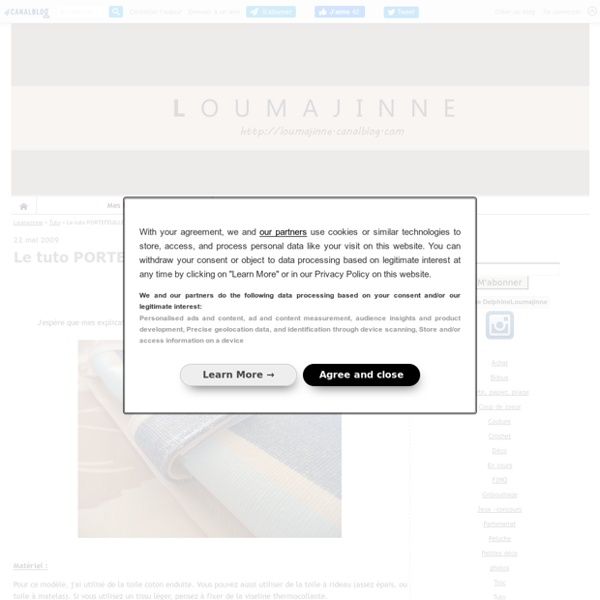
Portefeuille Porte Monnaie Bon, on va voir si j'arrive à être claire, ce qui n'est pas gagné, je men excuse d'avance!! Voici le tuto du porte-feuille fait il y a quelques jours. Il est à adapter selon ce que vous souhaitez avoir comme taille et nombre de poches! Moi, j'ai choisi de tout réunir: cartes, monnaie, chéquier avec un petit stylo, papiers d'identité et de véhicule. Prenez un tissu relativement épais pour la tenue, ou bien doublez entre les 2 épaisseurs. J'ai utilisé une bande de tissu de 84 cm sur 23 (avec les marges), qui fait directement la doublure extérieure à la fin de la réalisation. Commencez par préparer la partie porte-monnaie, avec 2 poches à cartes sur le devant si vous le souhaitez. Ce qui ressemble au final à une trousse plate: Définissez sur papier ce dont vous avez besoin. Attaquez votre grande bande de tissu par le bas en laissant un centimètre de marge pour la couture finale. Une fois vos poches définies et repassées, cousez le milieu sur l'envers en commençant par le haut! Puis les 2 côtés.
Laisse Luciefer: Tuto Photo - Sac Trapèze - Débutante vendredi 5 avril 2013 Le TRAPEZE - Sac zippé pour débutante Premier tuto, 2e essai de sac avec fermeture éclair, bref il y a du challenge dans l'air. de la mort qui tue- le stylo magique qui disparaît comme par magie - les ciseaux de précision que je chérie de tout mon cœur- la règle patch , le cutter rotatif et le tapis de découpe A1 méga indispensables Je marque mes créations avec des étiquettes thermocollantes que je vous conseille (voir cet article pour avoir plus d'infos et un bon de réduction).1 - Découpe du Tissu : Légende :- H : Haut- B : Bas- D : Droite- G : Gauche- T : Tissu- D : Doublure- découper un gabarit du triangle ci dessous dans du carton ou papier épais 2 - DimensionsLes dimensions du sac sont très facilement adaptables. - on fait la même chose pour la 2e anse - on coud au point droit de chaque côté des anses5 - Poches- on replie tous les bords de la poche puis on les marque au ferJ'utilise des chutes de tissus pour faire mes poches intérieures - on coud le haut de la poche
Macaron Coin Purse Just can’t help for not sewing these sweet little macaron coin purses when one of Craft Passion’s Facebook fans showed them to me. Thanks to XYZZhandmade for her inspiring handmade and some tutorial links in Japanese, this, this, this and this. No, I can’t read Japanese but I can guess from the pictures on how to sew it. Here is the English version of tutorial on how to sew this macaron coin purse where I have added more details in the sewing. The space inside the coin purse is quite limited but good enough to place some small jewelries like ear rings, rings; may be to keep some small coins, folded money; a place to keep small piece of note that wrote your shopping list and reminder etc. I have tried both nylon and metal zipper, each gave different feel and effect on the macaron coin purse.
Arm Candy For You: Tutorial sobre cómo hacer espaciosos bolsillos 3 D I make loads of purses & one thing that is essential for a purse/bag is pockets!!!!!!! Everywhere I see the pockets are same.Sew on 3 sides & you are done.You know what,I don't like them!!!!!!!! The pockets should have room to keep things in it....................so I make 3 D pockets & I am going to share it with you all too:) I will explain how to make 2 types of pockets. Now we all carry gadgets right?????? What would a girl do without her i-phone,blackberry,kindle etc etc .................. Cut- 2 pieces from the pocket fabric-6.5" by 6". 1 piece batting -6.5" by 6". It is OK to sew at the edges as after turning it we will be top stitching all four sides. Now turn this inside out so that the pocket fabric is at the front & back with the batting in the center. Turn the fabric on the 4th unstitched side 1/4" inside & top stitch it.So you will get a padded pocket patch of 6" by 5.5". Now to add the pleats to make the pocket 3 D. Back-stitch all the edges. at the pleats.
3 jupes Par Eolune, le 16/08/2010 dans Tutoriels T&N Souvent, on a envie de porter nos tuniques mais elles sont un peu courtes…ou bien nos robes un peu transparentes…ou tout simplement envie d’une nouvelle jupe toute simple ! Qu’à cela ne tienne, voici 3 tutos de jupes ou jupons trèèèès faciles à porter seul ou en superposition 1 – La jupe de base qui va à tout le monde/Le jupon court de dessous Matériel : De l’élastiqueTissu : une hauteur de jupe (astuce : généralement, je prends 70cm)En plus : dentelle ou biais pour le bas de la jupe Marche à suivre : Couper cette pièce deux fois, un devant, un derrièreAssembler les côtés de la jupeFaire une coulisse en haut pour passer un élastiqueFaire l’ourlet du basPorter Résultat : La jupe violette dessous est faite sur ce tuto. 2 – La jupe à panneaux, que j’aime porter longue sous une robe ou une tunique Pour une jupe en 4 panneaux Résultats : Les deux sont basées sur 2m de diamètre. 3 – Le jupon plus “bohème” et avec beaucoup plus d’ampleur Marche à suivre :
Le porte chéquier tout en 1 C'est avec une petite fierté personnelle que je poste ce billet. En effet je viens de terminer mon tout premier tuto couture! Je suis en pleine réalisation d'un colis pour une copinaute et la jolie voulait de la couture made by So Lovely. Je lui ai demandé de choisir un coupon ( comme ca j'étais au moins sur qu'il y ai un truc qui lui plaise ^^) et apres avoir faire un premier cadeau il me restait du tissu. En discutant avec elle je me rend compte qu'un petit portefeuille lui ferait plaisir. Je fonce donc dans la liste de favoris de mes tutos du net et rien à ce sujet... je fouille alors et rien, enfin si je suis tombée sur de jolis tutos mais jamais de ce que je voulais c'est à dire un tuto pour PorteFueille 4 en 1: porte chéquier, porte carte , porte billet ET porte monnaie. J'ai donc pris ma plus belle règle , ma plus belle feuille de papier et mon porte chéquier et je me suis mise au travail. Une nuit de repos et hop je le test à la lettre et hop un portefeuille est arrivé... Matériel :
Small zippered bag tutorial | Sewn Up by TeresaDownUnder This bag was designed to carry a small notebook as the largest item but you can adapt it to any size. It can even be turned into an iPad or e-book reader bag. It has two external zippered pockets and 3 internal ones. It was designed to carry a sketch notebook and a number of swipe cards without needing to take them out of their pockets. It has also a key holder. Instructions This project can be made with scrap fabrics. Seam allowance is 1/4 in. To customise the size, you need to measure the largest item all the way around, height and width. Divide each figure by 2 and write down. Now add 1 inch to each figure. I used the following measurements: Fabric 2 outside panels: 8 in x 10 in each2 inside panels: 8 in x 10 each43 in x 2 1/4 in for the strapone inside pocket: 8 in x 8 1/2 in folded in half and stitch into a tubefront pocket: 2 pieces measuring 8 in x 4 1/4 in Interfacing Other Making the inside pocket Take the inside pocket piece and fold it in two. Pin and stitch along the wide side. Pin.
★ HOW TO Make PURSES | WALLETS | POUCHES | CASES ★ There are many fabrics out there which can make for a confusing choice, however if you're a beginner I would definitely recommend cotton or linen first. Nothing too thin or flimsy, unless you are doing to add interfacing to stiffen it, or batting to bulk it up. Quilt weight cotton is most common. Home décor and upholstery fabrics are often used too as they're quite sturdy and durable. Other fabrics you can use are leather (or faux leather), vinyl, canvas, silk, wool, calico or denim. You can also reuse other materials such as vintage tablecloths, or even sweaters (however watch out for sweaters as they stretch unless you felt them first in hot water). - For linings, a thinner material than the outside is used and it is often smooth and slippery such as polyester or nylon. - There are various fastenings and closures you can use for purses, with the most common being zippers, button flaps, velcro and magnetic snaps. Click here, here and here for excellent interfacing information.
Hacer un bolso de boquilla… y salir razonablemente airoso. | Telaria venta de telas online Están aquí desde hace ya algún tiempo, no pasan desapercibidos. Son coquetos, fáciles, baratos y super personalizables. ¿Alguien aún tiene alguna duda de cómo se hace un bolso de boquilla? No es tarea difícil, pero hay que prestar atención a los detalles para que el acabado sea perfecto. Necesitamos dos cortes de telas combinadas, una para el exterior y otra para el interior, entretela, y boquilla. incluso si alguien no dispone de máquina de coser se puede animar a coserlo a mano, ya que es muy poco lo que hay que coser. El patrón se hace tomando como referencia la propia boquilla. Marcamos y cortamos el patrón dos veces en la tela exterior, la interior y la entretela. Con un trozo de tela de forro sobrante, cortamos un bolsillo para el interior, tomando como referencia el patrón, pero más corto. En el caso de la tela exterior del bolso, se cose dejando la parte superior del bolso sin coser, de marca a marca del fleje, teniendo en cuenta el margen de costura. Enséñanos tu versión!
Couture à la maison - Sewing at home: Comment réaliser la trousse de maquillage? En fait c'est une trousse à tout faire, pas seulement une trousse à maquillage (patron dans cet article). Et c'est très simple, c'est le même principe qu'une trousse normale. C'est en voyant les belles trousses de La Fée "petits pois" que j'ai eu envie d'en refaire une ce matin. Il suffit de faire le papillon. Il suffit ensuite de coudre les tissus extérieurs et les tissus intérieurs (en laissant un trou au fond), puis de former les coins, enfin retourner et coudre le trou de la doublure. Et voilà une trousse pour le kit à offrir de cette année.
Porte cartes So, how was your weekend? Mine was fun, but exhausting. I decided to go and visit TheSecondChild on Saturday. It’s a six hour drive, so I got up early and I was down there by noon. Anyway, last week. before all that excitement, I had fun making some little keychain cell phone id coin whatever-else-you-want-to-throw-in-there purses. They’re pretty easy to make and I thought you might like to make some too, so I took some pictures of the process and thought I’d write a little tutorial. Here’s a shot of the back of the purse with my cell phone tucked into the little pocket. So, shall we start? Some scraps of fabric — I used three different prints. Purse Back: Cut a 7″ long x 5 1/2″ wide piece of fabric. Quilt this little sandwich however you would like — stipple, straight lines, or make up your own. For the cell phone pocket, cut another piece of fabric, 8 1/2″ long x 4″ wide. Feed the elastic through the channel and secure the elastic at each end of the channel with a tacking stitch. Oops!
DIY Sunprint emballage | Design * Sponge My go-to DIY seems to perpetually be a tote bag. Once you’ve got the basic technique down, you can churn one out in less than an hour. I’m always looking for an excuse to make one, and I get most excited when I can add a simple twist to make it into something totally new and different. The full how-to is after the jump! MATERIALS: -1 yard of white duck cloth canvas -3/4 yard of navy blue duck cloth canvas -6 yards of navy blue double fold bias tape -navy blue thread -pocket fold template {download the “Sunprint Panel Fold Guide” here} -blue light sensitive dye & paint brush (we used Inkodye) -leaves & other clippings -4 large brass snaps -48″ of 1″ wide brown leather strap -8 medium brass rivets -stain protector (optional) TOOLS: -sewing machine -utility knife -hole punch -hammer -rivet-setting tool -snap-setting tool Directions: 1. 2. 3. 4. 5. 6. 7. 8. 9. 10. 11. 12. 13.
Tutorial: Pyramid studs n' plaid bag for fall -very img heavy!! I saw a picture of a cute bag in Lucky mag, and decided I could make my own version for a lot less than 285$!Here's the original bag: Pardon the crappy pic, but I couldn't be bothered to get the scanner out. Here's my version, somewhat "punked" up: I really like the way it looks but it's not as stiff as I would have liked (I was out of heavyweight interface and used a lighter weight type...big mistake ). Oh well! ***TUTORIAL****Well, this is my first tutorial and I hope it will make sense. The first thing you need to do is make a pattern. Next you need to get all your parts together. Here are all of the parts I used. For the flap closure, I used this pattern off my quilting cutting mat, but you can do any shape you like. You need a piece from the liner and a piece from the outer fabric, of course. I tried to show in the picture what I did.