

7 Apps for Teaching Children Coding Skills It's hard to imagine a single career that doesn't have a need for someone who can code. Everything that "just works" has some type of code that makes it run. Coding (a.k.a. programming) is all around us. That's why all the cool kids are coding . . . or should be. Programming is not just the province of pale twenty-somethings in skinny jeans, hunched over three monitors, swigging Red Bull. If you're concerned that that a) elementary school students don't have the ability to code, b) there's no room in the curriculum, and c) you don't possess coding chops to teach programming skills, throw out those worries. In no particular order, we have listed all the coding apps that are appropriate for young learners. GameStar Mechanic Platform: WebCost: $2 per student GameStar Mechanic teaches kids, ages 7-14, to design their own video games. Scratch Platform: WebCost: Free! Tynker Platform: WebCost: Free! Move the Turtle Hopscotch Platform: iPadCost: Free! Daisy the Dinosaur Platform: iPadCost: Free!
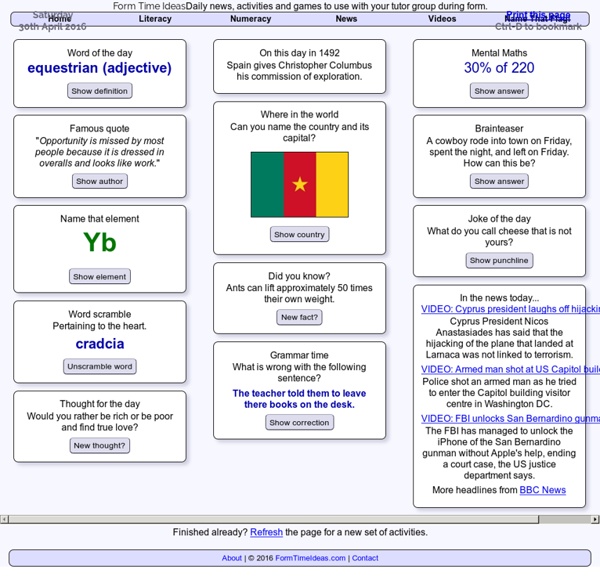
Games for Learning English, Vocabulary, Grammar Games, Activities, ESL Fun ideas for form time We've scoured the TES forums to bring you some of the best form time activities, tried and tested by experienced teachers. 1 Blockbusters and Countdown games Lots of our forum users recommend Countdown or Blockbusters style games for those with IWBs. You can download a Blockbusters game with added countdown numbers from TES Resources. You can also download a blank Blockbusters template uploaded by the cryptically named mflx9jaa, who suggests the following way to play: 'split the class into two teams (boys v girls perhaps). 2 News-based activities/discussions Here’s one from Ms_Galadriel: 'I tape Newsround one night a week, then show it to my Year 7 form class the next morning. Astralabe: ‘I keep a list of interesting quotes/poems/statistics/headlines I've amassed over time and usually put one of these up on the board at the start of registration. Get them discussing other 'hot issues' * Do you think our soldiers should stay in Iraq or not? 3 Reading 4 Educational Stop the Bus 6 A bit of mime
CGP Grey How do all the algorithms around us learn to do their jobs?**OMG PLUSHIE BOTS!!**: Bot Wallpapers on Patreon: Footnote: Podcasts: Thank you to my supporters on Patreon: James Bissonette, James Gill, Cas Eliëns, Jeremy Banks, Thomas J Miller Jr MD, Jaclyn Cauley, David F Watson, Jay Edwards, Tianyu Ge, Michael Cao, Caron Hideg, Andrea Di Biagio, Andrey Chursin, Christopher Anthony, Richard Comish, Stephen W. How neural networks really work with the real linear algebra: Music by: Show less Tools for teams and teamwork Sixth Form Tutor's ToolKit Attendance. Post 16 students don’t suddenly become well-organised human beings who attend registration, all their tutor sessions and their lessons! The first key to being a good tutor is to monitor student attendance and follow up any concerns. The School MI system provides Tutors with reports on a weekly, termly and yearly basis. There will be some students in the tutor group who are claiming EMA (education maintenance allowance), which relies on their 100% attendance, so tutors need to monitor their attendance carefully. Tutors are expected to know when each of the students in their tutor group are on site, and have a copy of their timetable. Building up a relationship. One of the most rewarding aspects of being a Post 16 Tutor is to build up a good relationship with the students so they feel that they can speak to you about any concerns they have. The Friday morning programme has been developed to ensure that students develop as broadminded individuals. Guidance. The student voice.
Ofsted 2012: Independent learning — From Good to Outstanding Banksy “Not all aspects of learning, for example pupils’ engagement, interest, concentration, determination, resilience and independence, will be seen in a single observation.” – April 2013 This is the only reference to independent learning in the latest Ofsted schedule. However, that doesn’t mean that we shouldn’t be encouraging students’ independence in their learning. With the spiralling access to information, skills and experiences, and the level of instant global communication, I believe it would be irresponsible not to support learners to develop their abilities to learn rather than to be taught. In the 2008 DCSF Independent learning literature review, the first key finding was, unsurprisingly that there are many definitions in operation regarding independent learning. “There are a number of different terms used to describe independent learning, the most common being ‘self-regulated learning’. Implication Postscript:
School council election tutor/form time activities | involver "You should move that bloomin' great big box", "No, you should", "They should", "Or her" I wrote these tutor/form time activities a while ago for a school I was working with in Coventry, not sure why I haven’t posted them until now. Often elections are just sprung upon a school without any preparation. No one thinks to explain to the whole school why they should choose to stand, or how they should choose who to vote for. What this ends up with is the same people (and the same kind of people) getting elected every year. Each one of these short sessions leads people towards an understanding of why they should stand to be a representative, or what they should consider when they are voting. Download the whole lot here 5 Tutor time activites to prepare for an election.zip (3.86 MB) or read more … There are 5 sessions plus the election itself. A) What is democracy? A - What is democracy (tutor time activity).zip (1.5 MB) B) What is a School Council? D) What is a representative? Practicalities Files