

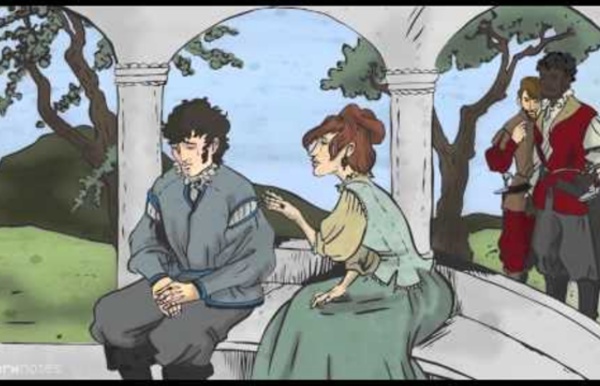
No Fear Shakespeare: A Midsummer Night’s Dream: Act 1 Scene 1 Page 2 Full of vexation come I with complaint Against my child, my daughter Hermia.— Stand forth, Demetrius. 25This man hath my consent to marry her Stand forth, Lysander. This man hath bewitched the bosom of my child Thou, thou, Lysander, thou hast given her rhymes, And interchanged love tokens with my child. 30Thou hast by moonlight at her window sung With feigning voice verses of feigning love, And stol'n the impression of her fantasy With bracelets of thy hair, rings, gauds, conceits, Knacks, trifles, nosegays, sweetmeats—messengers 35Of strong prevailment in unhardened youth. With cunning hast thou filched my daughter’s heart, Turned her obedience (which is due to me) To stubborn harshness. Be it so she will not here before your grace 40Consent to marry with Demetrius, I beg the ancient privilege of Athens. As she is mine, I may dispose of her— Which shall be either to this gentleman Or to her death—according to our law 45Immediately provided in that case.
How to Quote Shakespeare – Dr. Mark Womack Here is a quick guide on how to quote Shakespeare according to the standards set by the Modern Language Association (MLA). For more comprehensive information, consult the MLA Handbook, 8th edition (2016). Title and Reference Format Italicize the titles of plays.Richard III or Othello Place a parenthetical reference after each quotation containing its act, scene, and line numbers separated by periods. Prose Quotations If a prose quotation runs four lines or less, put it in quotation marks and incorporate it in the text.The immensely obese Falstaff tells the Prince: “When I was about thy years, Hal, I was not an eagle’s talon in the waist; I could have crept into any alderman’s thumb ring” (2.4.325–27). Verse Quotations Dialogue Quotations If you quote dialogue between characters in a play, set it as a block quotation as described above. How to Quote MLA Style » How to Quote » How to Quote Shakespeare
Tomb of Shakespeare | Mr. Mystery There is 'curse' in the 'tomb of Shakespeare' Do not ever expect to get rich with try to steal skeleton of well-known playwright, William Shakespeare, or try to keep it self to be infected his expertise in writing. Shakespeare was guess and predict how the greed of human behavior in future.Thus Shakespeare has prepared a curse to protect himself as already dead. Curse of Shakespeare engraved on the tomb is what might have been save the skeleton of the excavation.Excavation of the dead bone is common in Shakespeare's time, either for the purpose religious or research. Because of that fact, British playwright became very concerned incident like that would occur on its own skeleton. "Good frend for Jesus sake forebeare, / To digg the dust encloased heare;/ Bleste be the man That spares thes stones, / And curst be he That moves my bones, "said the text was engraved on the tomb of the author of The Four tragedies. Dr.