

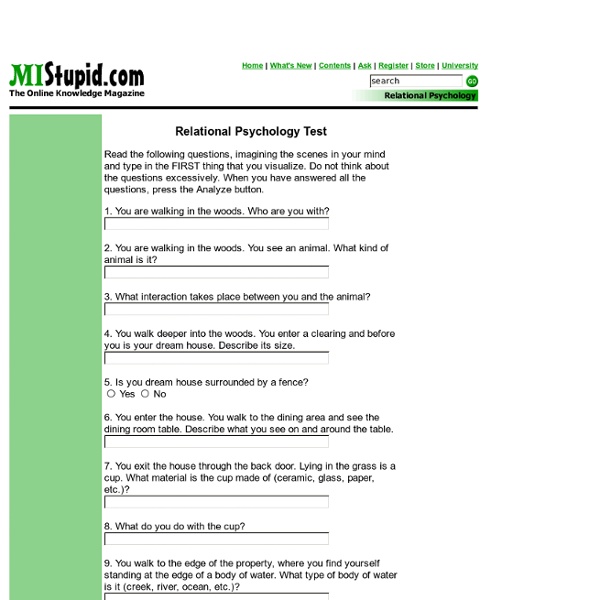
Funny Relational Psychology Tests - FFXI special box In the realms of medieval fantasy 1. You are walking in a field of rolling green grass and the wind is blowing soothingly upon your face when you see a box in the middle of the field. 2. 3. 4. 5. 6. If you are a girl, go to the next question. 7. 8. Results 1.This describes your personality.a. 2. 3. 4. 5. 6. 13 World Mysteries Without Explanation Chinese mosaic lines These strange lines are found at coordinates: 40°27’28.56″N, 93°23’34.42″E. There isn’t much information available on these strange, yet beautiful mosaic lines carved in the desert of the Gansu Sheng province in China. Some records indicate they were created in 2004, but nothing seems official. Unexplained stone doll The July 1889 find in Nampa, Idaho, of a small human figure during a well-drilling operation caused intense scientific interest last century. The find has never been challenged except to say that it was impossible. creationism.org The first stone calendar In the Sahara Desert in Egypt lie the oldest known astronomically aligned stones in the world: Nabta. During this time, the area was a savanna and supported numerous animals such as extinct buffalo and large giraffes, varieties of antelope and gazelle. 300 million year old iron screw At that time there were not only intelligent life forms on earth, not even dinosaurs. Ancient rocket ship Pyramid power
Tibetan Personality Test Dalai Lama Personality Test Take your time with this test and you will be amazed. I did this personality test last year when this came around and a spiritual wish I made did happen - in fact all year long. Just 4 questions and the answers will surprise you. This is an honest questionnaire which will tell you a lot about your true self. 1. 2. 3. 4. FINISHED? REPEAT your wish and press "Submit!" Back to personality tests , IQ test 11 cheap gifts guaranteed to impress science geeks Science comes up with a lot of awesome stuff, and you don't need a Ph.D, a secret lab, or government funding to get your hands on some of the coolest discoveries. We've got a list of 11 mostly affordable gifts that are guaranteed to blow your mind, whether or not you're a science geek. Click on any image to see it enlarged. 1. Also known as frozen smoke, Aerogel is the world's lowest density solid, clocking in at 96% air. Aerogel isn't just neat, it's useful. Price: $35 2. Inside these sealed glass balls live shrimp, algae, and bacteria, all swimming around in filtered seawater. EcoSpheres came out of research looking at ways to develop self-contained ecosystems for long duration space travel. Price: $80 3. NASA has been trying to figure out how to get a sample of rock back from Mars for a while now. Every once in a while, a meteorite smashes into Mars hard enough to eject some rocks out into orbit around the sun. Price: $70+ 4. Price: $150 5. So what's next year's new color going to be? 6.
Top 10 Thinking Traps Exposed Our minds set up many traps for us. Unless we’re aware of them, these traps can seriously hinder our ability to think rationally, leading us to bad reasoning and making stupid decisions. Features of our minds that are meant to help us may, eventually, get us into trouble. Here are the first 5 of the most harmful of these traps and how to avoid each one of them. 1. “Is the population of Turkey greater than 35 million? Lesson: Your starting point can heavily bias your thinking: initial impressions, ideas, estimates or data “anchor” subsequent thoughts. This trap is particularly dangerous as it’s deliberately used in many occasions, such as by experienced salesmen, who will show you a higher-priced item first, “anchoring” that price in your mind, for example. What can you do about it? Always view a problem from different perspectives. 2. In one experiment a group of people were randomly given one of two gifts — half received a decorated mug, the other half a large Swiss chocolate bar. 3. 4.
4 Practical Philosophies That Will Empower You Philosophy is a fascinating branch of wisdom. However these esoteric ideas are sometimes difficult to translate into practical application. What are all of those thoughts, suppositions and theories actually good for? How can an understanding of philosophy ultimately help you lead a better life? Today I want to examine with you four philosophical ideas that have influenced my life in a very positive way. 1) Friedrich Nietzsche – Eternal Recurrence The Idea Several times throughout his works, Nietzsche talks about the thought experiment of eternal recurrence. Does the idea of eternal recurrence – that every moment of your life will repeat itself into eternity – leave you shivering with fear or with joy; whether you are living life fully everyday or just waiting for better times to come. Heaven or hell, you decide Let’s also assume that the life you are currently living is not simply one of the repetitions but is actually your first time around. 2) Socrates – No One Does Wrong Willingly L’idée
This Is How Much Money You'll Make Based on Your Personality If you spent a lot of time on the Internet as a teen, you’ve taken approximately a bajillion personality tests. At least one was probably the hugely popular Myers-Briggs Type Indicator, which sorts people into 16 different groups with 4-letter names. The test, based off of Jungian psychiatry and developed by mother-daughter author duo Katharine Cooks Briggs and Isabelle Myers Briggs in 1962, is supposed to tell you if you are introverted or extraverted, intuitive or sensing, thinking or feeling and perceptive or judgmental. The types can then be divided into four groups: artisans, guardians, idealists and rationalists. Web Talent, careerassessmentsite.com Career Assessment Site, maintained by Jonathan Bollag, recently published an in-depth infographic that shows exactly how much money different personality types will likely make in their lives. You can see the full Myers-Briggs infographic here.
Tiny human almost-brains made in lab Largely left to their own devices, human stem cells knitted themselves into tissue with a multitude of brain structures and specialized cadres of neurons in a form reminiscent of the brain of a nine-week-old fetus, scientists report August 28 in Nature. The tissue doesn’t approach the dizzying complexity of the human brain. Yet these tiny neural balls, each no bigger than a BB pellet, represent the most complex brain structure grown in a lab to date, researchers say. “They’ve done something very remarkable,” says Flora Vaccarino of Yale University. After about two months of growing in a nutrient broth, the cells specialized into neurons that populated distinct, recognizable parts of the developing brain, such as the hippocampus, retina and choroid plexus, which produces cerebrospinal fluid in the brain. The tissue clumps also had discrete parts of the cerebral cortex, the outer sheet of the human brain that’s responsible for advanced thought processes. Back Story | DOES IT DREAM?
Mythical Creatures List, Mythical Creatures A-Z What Does Your Handwriting Say About You? What Does Your Handwriting Say About You? graphology Graphology is the study of handwriting, especially when employed as a means of analyzing a writer's character, personality, abilities, etc. How you write can indicate more than 5,000 different personality traits. In the medical field, it can be used to refer to the study of handwriting as an aid in diagnosis and tracking diseases. size large letters You are out-going, people oriented, outspoken & love attention. small letters You are shy or withdrawn, studious, concentrated and meticulous. average You are well-adjusted and adaptable spacing between words wide spacing You enjoy your freedom and don't like to be overwhelmed or crowded narrow spacing You can't stand to be alone. slanting No Slant You don't let your emotions get the best of you. Slants to the right You are open to new experiences & enjoy meeting new people. Slants to the left You tend to keep to yourself and generally like to work behind the scenes. shape of the letters Rounded letters Open
Wire your Brain to Pick up a New Language Today Have you ever wondered how some people can speak multiple languages fluently or how some people seem to pick up new languages little effort? Many of these people have used the Pimsleur Approach – A well known provider in audio-based language learning. It’s a unique method that’s been used by over 25 million people to quickly and effectively start speaking a new foreign language in just 10 days. Even the FBI purchased the Pimsleur Approach. The Secret to Start Speaking a Language in just 10 Days Revealed In today’s global society, learning a foreign language is crucial, whether you need it for work or pleasure. Pimsleur Approach Numerous studies have revealed that in most countries, native-speakers use only about 2,500 distinct words and phrases on a daily basis. The entire Pimsleur Approach is what language learning should be: quick, fun, and easy! Dr. Dr. Pimsleur Approach currently has a great special offer available.
40 Of The Most Powerful Photographs Ever Taken Sisters pose for the same photo three separate times, years apart. A Russian war veteran kneels beside the tank he spent the war in, now a monument. A Romanian child hands a heart-shaped balloon to riot police during protests against austerity measures in Bucharest. Retired Philadelphia Police Captain Ray Lewis is arrested for participating in the Occupy Wall Street protests in 2011. A monk prays for an elderly man who had died suddenly while waiting for a train in Shanxi Taiyuan, China. A dog named "Leao" sits for a second consecutive day at the grave of her owner, who died in the disastrous landslides near Rio de Janiero on January 15, 2011. The 1968 Olympics Black Power Salute: African American athletes Tommie Smith and John Carlos raise their fists in a gesture of solidarity at the 1968 Olympic games. Jewish prisoners at the moment of their liberation from an internment camp "death train" near the Elbe in 1945. John F. "Wait For Me Daddy," by Claude P. U.S.
Sports, Complexity, and the Ten-Thousand-Hour Rule Forty years ago, in a paper in American Scientist, Herbert Simon and William Chase drew one of the most famous conclusions in the study of expertise: In the years that followed, an entire field within psychology grew up devoted to elaborating on Simon and Chase’s observation—and researchers, time and again, reached the same conclusion: it takes a lot of practice to be good at complex tasks. After Simon and Chase’s paper, for example, the psychologist John Hayes looked at seventy-six famous classical composers and found that, in almost every case, those composers did not create their greatest work until they had been composing for at least ten years. (The sole exceptions: Shostakovich and Paganini, who took nine years, and Erik Satie, who took eight.) This is the scholarly tradition I was referring to in my book “Outliers,” when I wrote about the “ten-thousand-hour rule.” Recently, there has been some confusion about this argument. Regardless of a person’s natural aptitude?