

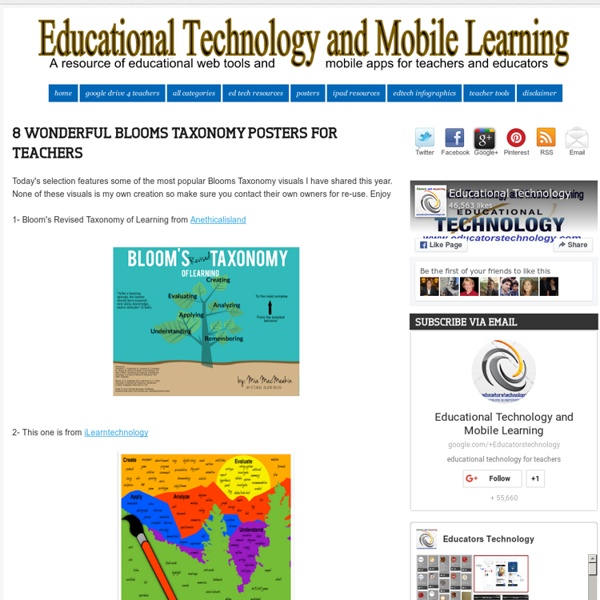
home Blooming Orange: Bloom's Taxonomy Helpful Verbs Poster Here’s another poster to help get you thinking about how you can apply Bloom’s higher-order thinking skills with your children. This poster shows the segments of an orange with each segment relating to a thinking skill and some helpful verbs to serve as prompts. While there are many more verbs that we could have added, we felt that including just seven in each segment would make them easier to remember (For more information, see Miller’s paper “The Magical Number Seven, Plus or Minus Two: Some Limits on Our Capacity for Processing Information.” We thought it would be interesting to depict the verbs in a circular form as opposed to a hierarchical list, given that these skills don’t often occur in isolation and are interconnected. For those of you who prefer it, we’ve also created a grayscale version of the poster. Let us know what you think – you know we’re always listening! Download the pdf’s here:
Custom Metal Roll Forming Solutions | Premier Steel Technologies Rollforming is a versatile and productive metal forming method in the manufacture of components made from coil steel and other metals. It has become a fast and efficient method of steel forming for large volume production. Here, we have perfected these custom roll forming methods, and have developed cost effective production methods of both large and small quantities. At Premier Steel Technologies, we now have approximately 15 roll forming machines, with varying sizes and configurations. You can expect the best from us, while we strive to bring you the best in custom roll forming solutions that allow us to serve you with total dedication.
VisualBlooms - home Bloom's Taxonomy Mary Forehand The University of Georgia Introduction One of the basic questions facing educators has always been "Where do we begin in seeking to improve human thinking?" (Houghton, 2004). Fortunately we do not have to begin from scratch in searching for answers to this complicated question. Benjamin S. Although it received little attention when first published, Bloom's Taxonomy has since been translated into 22 languages and is one of the most widely applied and most often cited references in education. History In 1780, Abigail Adams stated, "Learning is not attained by chance; it must be sought for with ardor and attended to with diligence" ( quotationspage.com, 2005). Discussions during the 1948 Convention of the American Psychological Association led Bloom to spearhead a group of educators who eventually undertook the ambitious task of classifying educational goals and objectives. What is Bloom's Taxonomy? Clearly, Bloom's Taxonomy has stood the test of time. Terminology Changes Summary
249 Bloom's Taxonomy Verbs For Critical Thinking 100+ Bloom’s Taxonomy Verbs For Critical Thinking by TeachThought Staff Ed note: This post was first published in 2013 and updated in December of 2019 Bloom’s Taxonomy’s verbs–also know as power verbs or thinking verbs–are extraordinarily powerful instructional planning tools. In fact, in addition to concepts like backward-design and power standards, they are one of the most useful tools a teacher-as-learning-designer has access to. They can be used for curriculum mapping, assessment design, lesson planning, personalizing and differentiating learning, and almost any other ‘thing’ a teacher–or student–has to do. For example, if a standard asks students to infer and demonstrate an author’s position using evidence from the text, there’s a lot built into that kind of task. Though the chart below reads left to right, it’s ideal to imagine it as a kind of incline, with Knowledge at the bottom, and Create at the top. 100+ Bloom’s Taxonomy Verbs For Critical Thinking
What Is Bloom's Taxonomy? A Definition For Teachers - by TeachThought Staff In one sentence, Bloom’s Taxonomy is a hierarchical ordering of cognitive skills that can, among countless other uses, help teachers teach and students learn. For example, Bloom’s Taxonomy can be used to: create assessments plan lessons (see 249 Bloom’s Taxonomy Verbs For Critical Thinking) evaluate the complexity of assignments design curriculum maps develop online courses plan project-based learning self-assessment more See How To Teach With Bloom’s Taxonomy for more reading. A Brief History Of Bloom’s Taxonomy Revisions Bloom’s Taxonomy was created by Benjamin Bloom in 1956, published as a kind of classification of learning outcomes and objectives that have, in the more than half-century since, been used for everything from framing digital tasks and evaluating apps to writing questions and assessments. The original sequence of cognitive skills was Knowledge, Comprehension, Application, Analysis, Synthesis, and Evaluation. How Bloom’s Taxonomy Is Useful For Teachers 1. 2. 3.
The Other 21st Century Skills: Educator Self-Assessment Chartkamp–I think I understand what you are saying, but in any scenario, someone, or something will spur the impetus for learning to occur. We could have a toddler go about and learn the world from scratch, but I don’t think anyone would say that is as efficient and as effective as a “parent” facilitating, or at least providing for a safe environment. And the better the parent, the more effective the toddler will be at contributing to the learning within the community as he/she progresses. Can you describe what you mean by informal learning? I can take that to be exploratory, on your own, as equals, not in a classroom, and so many more ways. Take the place, school, out of the equation.
A Very Good Checklist for Assessing 21st Century Learning Skills January 29, 2015 Here is another great resource from Dr. Jackie Gerstein, one of our favourite EdTech bloggers. Jackie designed this beautiful chart featuring 12 attributes and skills that teachers should tend to in their instruction. What I like the most about this chart is the fact that it emphasizes the social and affective component in learning, something which is often overlooked in today’s digitally-focused learning paradigms. Jackie's set of attributes featured in this chart chime in with Giroux's view of education as a way of producing citizens who are 'critical, self-reflective, knowledgeable and willing to make moral judgements and act in a socially responsible way.' Check out Jackie's original post to access more resources and links accompanied with this chart.
SAMR is not a ladder, a word of warning Published on May 26th, 2015 | by Mark Anderson I’m as guilty as the next person for singing the praises of Puentedura’s SAMR model. I’ve blogged about it many many times, it’s included in my book ‘Perfect ICT Every Lesson’ too. Quite rightly so I believe. The problem I have with it, and others find this problem too, is that it is seen as being a taxonomy, a ladder upon which to be climbed. Redefinition is seen as being the creativity to Blooms or the sharing of Vygotsky’s Zones of Proximal Development – the top rung of a difficult ladder to climb. The problem for me is, like any tool, technology is only as good as the person using it. The trick is, technology use is at its best when it is purposeful. App smashing is a great way to help young people hit redefinition in the work that they create. I’m not the only one who is saying this. Miguel Guhlin compiles a number of these ‘anti-SAMR’ posts together in his post, “Tearing Down False gods: SAMR Pushback Begins” and it is a good read.