

Frugivore Frugivore seed dispersal[edit] Seed dispersal is important for plants because it allows their progeny to move away from their parents in space and time. The advantages of seed dispersal may have led to the evolution of fleshy fruits, which entice animals to eat the fruits and move the plants seeds from place to place. While many fruit producing plant species would not disperse far without frugivores, they can usually germinate even if they fall to the ground directly below the parent plant. Many types of animals are seed dispersers. Plant adaptations to attract dispersers[edit] There are a number of fruit characteristics that seem to be adaptive characteristics to attract frugivores. Frugivore adaptations for fruit consumption[edit] In order for frugivores to be good seed dispersers they must digest fruits without consuming a high proportion of the seeds. Plant mechanisms to delay or deter frugivory[edit] Plants invest energy into the production of fruits. Physical deterrents [6] Levey, D.
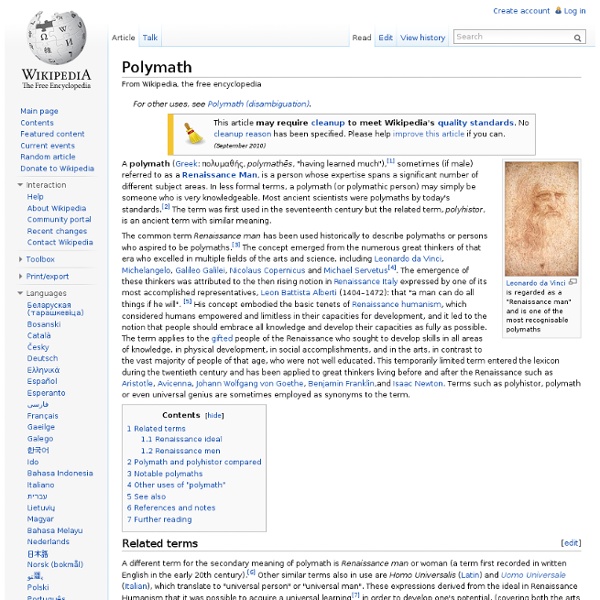
Multipotentiality Multipotentiality is an educational and psychological term referring to the ability of a person, particularly one of intellectual or artistic curiosity, to excel in two or more different fields.[1] It can also refer to an individual whose interests span multiple fields or areas, rather than being strong in just one. Such individuals are called "multipotentialites." On the contrary, those whose interests lie mostly within a single field are called "specialists." While the term multipotentialite can be used interchangeably with polymath or Renaissance Person, the terms are not identical. Leonardo da Vinci may be the best historical example of an acknowledged genius who struggled with the difficulties associated with multipotentiality. Other notable multipotentialites throughout history are Averroes, Thomas Jefferson, Benjamin Franklin, René Descartes, Sir Isaac Newton, and Aristotle. External links[edit] Notes[edit]
Prosody (linguistics) "Prosodic structure" is important in language contact and lexical borrowing. For example, in Modern Hebrew, the XiXéX verb-template is much more productive than the XaXáX verb-template because in morphemic adaptations of non-Hebrew stems, the XiXéX verb-template is more likely to retain – in all conjugations throughout the tenses – the prosodic structure (e.g., the consonant clusters and the location of the vowels) of the stem.[2] Unique prosodic features have been noted in infant-directed speech (IDS) - also known as baby talk, child-directed speech (CDS), or motherese. Prosody is useful for listeners as they perform sentence parsing. Prosody is also useful in expressing (for speakers) and detecting (for listeners) sarcasm. Emotional prosody is the expression of feelings using prosodic elements of speech. Anger and sadness: High rate of accurate identificationFear and happiness: Medium rate of accurate identificationDisgust: Poor rate of accurate identification
Theory of multiple intelligences The theory of multiple intelligences is a theory of intelligence that differentiates it into specific (primarily sensory) "modalities", rather than seeing intelligence as dominated by a single general ability. This model was proposed by Howard Gardner in his 1983 book Frames of Mind: The Theory of Multiple Intelligences. Gardner articulated seven criteria for a behavior to be considered an intelligence.[1] These were that the intelligences showed: potential for brain isolation by brain damage, place in evolutionary history, presence of core operations, susceptibility to encoding (symbolic expression), a distinct developmental progression, the existence of savants, prodigies and other exceptional people, and support from experimental psychology and psychometric findings. Gardner argues intelligence is categorized into three primary or overarching categories, those of which are formulated by the abilities. The different abilities[edit] Musical–rhythmic and harmonic[edit] Interpersonal[edit]
Syntactic ambiguity Syntactic ambiguity arises not from the range of meanings of single words, but from the relationship between the words and clauses of a sentence, and the sentence structure implied thereby. When a reader can reasonably interpret the same sentence as having more than one possible structure, the text meets the definition of syntactic ambiguity. In legal disputes, courts may be asked to interpret the meaning of syntactic ambiguities in statutes or contracts. Different forms of syntactic ambiguity[edit] Globally ambiguous[edit] A globally ambiguous sentence is one that has at least two distinct interpretations. Locally ambiguous[edit] A locally ambiguous sentence is a sentence that contains an ambiguous phrase but has only one interpretation. One example of a local ambiguity is "The cat jumped over the fence stretched." Examples[edit] The duke yet lives that Henry shall depose. — Henry VI (1.4.30), by Shakespeare John saw the man on the mountain with a telescope. Who has the telescope?
Gifted education Gifted education (also known as Gifted and Talented Education (GATE), Talented and Gifted (TAG), or G/T) is a broad term for special practices, procedures, and theories used in the education of children who have been identified as gifted or talented. There is no standard global definition of what a gifted student is. In 2011, the National Association for Gifted Children published a position paper that defined what a gifted student is. The term "gifted," in that position paper, describes individuals who demonstrate outstanding aptitude or competence in one or more domains. An "aptitude" is there defined as an exceptional ability to learn or reason. History[edit] Classical era to Renaissance[edit] Gifted and talented education dates back thousands of years. Sir Francis Galton[edit] Lewis Terman[edit] At Stanford University in 1918, Lewis Terman adapted Alfred Binet's Binet-Simon intelligence test into the Stanford-Binet test, and introduced intelligence quotient (IQ) scoring for the test.
Quaintrelle Sporty Parisian dandies of the 1830s: a tight corset helped one achieve his silhouette. The man on the left wears a frock, the man on the right wears a morning dress Though previous manifestations of the petit-maître (French for small master) and the Muscadin have been noted by John C. Charles Baudelaire, in the later, "metaphysical" phase of dandyism[5] defined the dandy as one who elevates æsthetics to a living religion,[6] that the dandy's mere existence reproaches the responsible citizen of the middle class: "Dandyism in certain respects comes close to spirituality and to stoicism" and "These beings have no other status, but that of cultivating the idea of beauty in their own persons, of satisfying their passions, of feeling and thinking .... Etymology[edit] Beau Brummell and early British dandyism[edit] Another prominent dandy of the period was Alfred Guillaume Gabriel d'Orsay, the Count d'Orsay, who had been friends with Byron and who moved in the highest social circles of London.
Latent inhibition Theories[edit] The LI effect has received a number of theoretical interpretations. One class of theory holds that inconsequential stimulus pre-exposure results in reduced associability for that stimulus. The loss of associability has been attributed to a variety of mechanisms that reduce attention, which then must be reacquired in order for learning to proceed normally.[2] Alternatively, it has been proposed that LI is a result of retrieval failure rather than acquisition failure.[3] Such a position advocates that, following stimulus pre-exposure, the acquisition of the new association to the old stimulus proceeds normally. Variation[edit] LI is affected by many factors, one of the most important of which is context. Physiology[edit] The assumption that the attentional process that produces LI in normal subjects is dysfunctional in schizophrenia patients has stimulated considerable research, with humans, as well as with rats and mice. Pathology[edit] Low latent inhibition[edit] Notes[edit]
Idioglossia An idioglossia is an idiosyncratic language invented and spoken by only one person or very few people. Most often, idioglossia refers to the "private languages" of young children, especially twins, the latter being more specifically known as cryptophasia, and commonly referred to as twin talk or twin speech. Children who are exposed to multiple languages from birth are also inclined to create idioglossias, but these languages usually disappear at a relatively early age, giving way to use of one or more of the languages introduced. Examples[edit] Case studies[edit] Sam and Ren McEntee, 17-month-old twins.[1]June and Jennifer GibbonsKennedy twins of San Diego, California, who were subjected to intensive study, including an exhaustive analysis of their language. Media[edit] See also[edit] References[edit] Further reading[edit] Bakker, P. (1987).
Emotional intelligence Emotional intelligence (EI) can be defined as the ability to monitor one's own and other people's emotions, to discriminate between different emotions and label them appropriately, and to use emotional information to guide thinking and behavior.[1] There are three models of EI. The ability model, developed by Peter Salovey and John Mayer, focuses on the individual's ability to process emotional information and use it to navigate the social environment.[2] The trait model as developed by Konstantin Vasily Petrides, "encompasses behavioral dispositions and self perceived abilities and is measured through self report" [3] The final model, the mixed model is a combination of both ability and trait EI, focusing on EI being an array of skills and characteristics that drive leadership performance, as proposed by Daniel Goleman.[4] It has been argued that EI is either just as important as one's intelligence quotient (IQ). History[edit] Definitions[edit] Ability model[edit] Measurement[edit]
Intelligence quotient IQ scores have been shown to be associated with such factors as morbidity and mortality,[2][3] parental social status,[4] and, to a substantial degree, biological parental IQ. While the heritability of IQ has been investigated for nearly a century, there is still debate about the significance of heritability estimates[5][6] and the mechanisms of inheritance.[7] History[edit] Early history[edit] The English statistician Francis Galton made the first attempt at creating a standardised test for rating a person's intelligence. French psychologist Alfred Binet, together with Victor Henri and Théodore Simon had more success in 1905, when they published the Binet-Simon test in 1905, which focused on verbal abilities. The score on the Binet-Simon scale would reveal the child's mental age. General factor (g)[edit] The many different kinds of IQ tests use a wide variety of methods. An illustration of Spearman's two-factor intelligence theory. The War Years in the United States[edit] L.L. John B.