

Carbon shifting Carbon shifting is the tendency for an individual to increase carbon dioxide emissions in one area of their lifestyle as a result of reducing emissions elsewhere. ‘Carbon shifting’ might more accurately be termed ‘domestic carbon shifting’ to distinguish it from carbon leakage which has occasionally also been called carbon shifting.[1] Many attempts to encourage people to change aspects of their lifestyle and so reduce their carbon dioxide emissions make a virtue of the financial savings. In the United Kingdom the Energy Saving Trust lists various ways of saving energy, e.g. “Energy saving light bulbs last up to 12 times longer than ordinary lightbulbs and can save you £9 per year in electricity (and 38 kilograms of CO2) or £100 over the bulbs lifetime.” [2] However, whether or not carbon dioxide emissions are ultimately reduced will depend on how that saved money is spent. See also[edit] Notes[edit]
Aarhus Convention The UNECE Convention on Access to Information, Public Participation in Decision-making and Access to Justice in Environmental Matters, usually known as the Aarhus Convention, was signed on 25 June 1998 in the Danish city of Aarhus. It entered into force on 30 October 2001. As of March 2014, it has 47 parties—46 states and the European Union.[1] All of the ratifying states are in Europe and Central Asia. The Aarhus Convention grants the public rights regarding access to information, public participation and access to justice, in governmental decision-making processes on matters concerning the local, national and transboundary environment. Content[edit] General features[edit] The Aarhus Convention is a rights-based approach: the public, both in the present and in future generations, have the right to know and to live in a healthy environment. The Three Pillars[edit] Access to information: any citizen should have the right to get a wide and easy access to environmental information.
Permaculture With its system of applied education, research and citizen- led design permaculture has grown a popular web of global networks and developed into a global social movement[citation needed]. The term permaculture was developed and coined by David Holmgren, then a graduate student at the Tasmanian College of Advanced Education's Department of Environmental Design, and Bill Mollison, senior lecturer in Environmental Psychology at University of Tasmania, in 1978. [1] The word permaculture originally referred to "permanent agriculture",[3] but was expanded to stand also for "permanent culture", as it was understood that social aspects were integral to a truly sustainable system as inspired by Masanobu Fukuoka’s natural farming philosophy. It has many branches that include, but are not limited to, ecological design, ecological engineering, regenerative design, environmental design, and construction. History[edit] Several individuals revolutionized the branch of permaculture. In Australian P.A.
Gullibility Failure of social intelligence Gullibility is a failure of social intelligence in which a person is easily tricked or manipulated into an ill-advised course of action. It is closely related to credulity, which is the tendency to believe unlikely propositions that are unsupported by evidence. Classes of people especially vulnerable to exploitation due to gullibility include children, the elderly, and the developmentally disabled.[3] Meaning The words gullible and credulous are commonly used as synonyms. Yamagishi, Kikuchi & Kosugi (1999) characterize a gullible person as one who is both credulous and naïve. Etymology and history The verb to gull and the noun cullibility (with a C) date back to Shakespeare and Swift, whereas gullibility is a relatively recent addition to the lexicon. Examples Greenspan (2009) presents dozens of examples of gullibility in literature and history: Theories Against gullibility The relationship between gullibility and trust has led to alternate theories. See also Notes
Carbon leakage Carbon leakage occurs when there is an increase in carbon dioxide emissions in one country as a result of an emissions reduction by a second country with a strict climate policy. Carbon leakage may occur for a number of reasons: if the emissions policy of a country raises local costs, then another country with a more relaxed policy may have a trading advantage. If demand for these goods remains the same, production may move offshore to the cheaper country with lower standards, and global emissions will not be reduced.if environmental policies in one country add a premium to certain fuels or commodities, then the demand may decline and their price may fall. Countries that do not place a premium on those items may then take up the demand and use the same supply, negating any benefit. There is no consensus over the magnitude of long-term leakage effects.[1] This is important for the problem of climate change, which covers long time periods. Coal, oil and "backstop" technologies[edit]
Green gross domestic product The green gross domestic product (green GDP) is an index of economic growth with the environmental consequences of that growth factored into a country's conventional GDP. Green GDP monetizes the loss of biodiversity, and accounts for costs caused by climate change. Some environmental experts prefer physical indicators (such as "waste per capita" or "carbon dioxide emissions per year"), which may be aggregated to indices such as the "Sustainable Development Index". Calculating Green GDP[edit] Calculating green GDP requires that net natural capital consumption, including resource depletion, environmental degradation, and protective and restorative environmental initiatives, be subtracted from traditional GDP.[1] Some early calculations of Green GDP take into account one or two, but not all environmental adjustments. Rationale[edit] The motivation for creating a Green GDP originates from the inherent limitations of GDP has as an indicator of economic performance and social progress.
Environmental social science Environmental social science is the broad, transdisciplinary study of interrelations between humans and the natural environment. Environmental social scientists work within and between the fields of anthropology, communication studies, economics, geography, history, political science, psychology, and sociology; and also in the interdisciplinary fields of environmental studies, human ecology and political ecology, among others. See also[edit] References[edit] Berkhout, Frans, Melissa Leach, and Ian Scoones. 2003. External links[edit] Environment and Society: Scholarly Journals
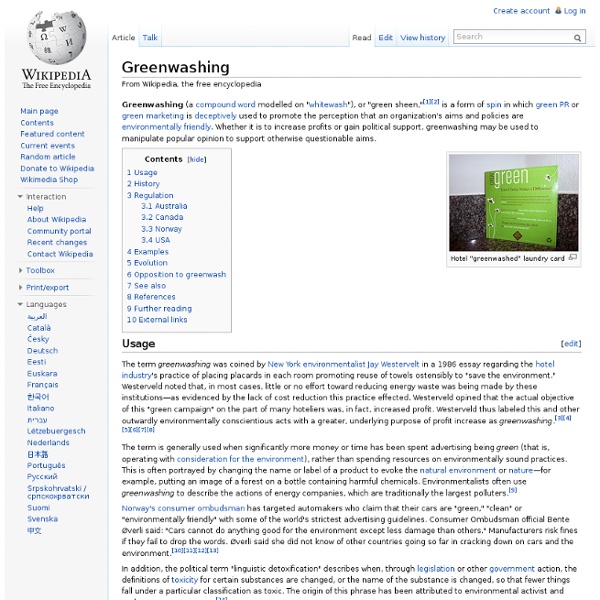
Greenwashing Use of the aesthetic of conservationism to promote organisations An example of greenwashing is when an organization spends significantly more resources on advertising being "green" than on environmentally sound practices.[4] Greenwashing can range from changing the name or label of a product to evoke the natural environment (for example on a product containing harmful chemicals) to multimillion-dollar campaigns that portray highly-polluting energy companies as eco-friendly. Greenwashing covers up unsustainable corporate agendas and policies.[5] Highly public accusations of greenwashing have contributed to the term's increasing use.[6] Many corporations use greenwashing to improve public perception of their brands. Greenwashing has increased in recent years to meet consumer demand for environmentally-friendly goods and services. Characteristics[edit] History[edit] In the mid-1960s, the environmental movement gained momentum. The first Earth Day was held on April 22, 1970. Examples[edit]
Global-warming potential Global-warming potential (GWP) is a relative measure of how much heat a greenhouse gas traps in the atmosphere. It compares the amount of heat trapped by a certain mass of the gas in question to the amount of heat trapped by a similar mass of carbon dioxide. A GWP is calculated over a specific time interval, commonly 20, 100 or 500 years. The substances subject to restrictions under the Kyoto protocol either are rapidly increasing their concentrations in Earth's atmosphere or have a large GWP. The GWP depends on the following factors: the absorption of infrared radiation by a given speciesthe spectral location of its absorbing wavelengthsthe atmospheric lifetime of the species Thus, a high GWP correlates with a large infrared absorption and a long atmospheric lifetime. Calculating the global-warming potential[edit] The radiative forcing capacity (RF) is the amount of energy per unit area, per unit time, absorbed by the greenhouse gas, that would otherwise be lost to space. Values[edit]
Social responsibility Social responsibility is an ethical theory that an entity, be it an organization or individual, has an obligation to act to benefit society at large. Social responsibility is a duty every individual has to perform so as to maintain a balance between the economy and the ecosystems. A trade-off may[citation needed] exist between economic development, in the material sense, and the welfare of the society and environment. Critics argue that Corporate social responsibility (CSR) distracts from the fundamental economic role of businesses; others argue that it is nothing more than superficial window-dressing; others argue that it is an attempt to pre-empt the role of governments as a watchdog over powerful corporations though there is no systematic evidence to support these criticisms. Student social responsibility[edit] Student social responsibility is the responsibility of every student for his/her actions. Corporate social responsibility[edit] See also[edit] Notes[edit] References[edit]
List of environmental journals This is a list of scholarly, peer-reviewed academic journals focused on the biophysical environment and/or humans' relations with it. Inclusion of journals focused on the built environment also is appropriate. Included in this list are journals from a wide variety of interdisciplinary fields including from the environmental sciences, environmental social sciences, environmental humanities, etc. General[edit] Climate change[edit] Nature Climate Change - published by Nature Publishing Group Energy and renewable energy[edit] See also: Environmental and energy law, below Environmental and energy law[edit] Environmental economics[edit] Environmental health[edit] Environmental humanities[edit] Environmental sciences[edit] Environmental social sciences[edit] See also[edit] References[edit] External links[edit]
Half-truth Deceptive statement The purpose and or consequence of a half-truth is to make something that is really only a belief appear to be knowledge, or a truthful statement to represent the whole truth or possibly lead to a false conclusion. The order in which the true and false information is presented in a "half-truth" can make a difference in ultimate believability.[2] Barchetti and colleagues show that when two unrelated statements are put together with syntax that suggests causality, the statement is believed if the premise is true (even if the conclusion is unrelated or false). In January 2018, U.S. Some forms of half-truths are an inescapable part of politics in representative democracies. William Safire defines a half-truth, for political purposes, as "a statement accurate enough to require an explanation; and the longer the explanation, the more likely a public reaction of half-belief".[7] Now we expect many things of politicians in a well-functioning parliamentary democracy. [edit]
Water footprint and virtual water International trade in food and other products implies international flows of virtual water. Virtual water is the water that is virtually embedded in traded commodities. It refers to the water footprint of a commodity in the place of production. The global volume of international virtual water flows in relation to trade in agricultural and industrial products averaged 2320 billion m3 per year during the period 1996-2005 (Mekonnen and Hoekstra, 2011). The major gross virtual water exporters were the USA, China, India, Brazil, Argentina, Canada, Australia, Indonesia, France and Germany and the major gross virtual water importers were the USA, Japan, Germany, China, Italy, Mexico, France, the UK and the Netherlands. For water-scarce countries it can sometimes be attractive to import virtual water (through import of water-intensive products), thus relieving the pressure on the domestic water resources.