

Cetacean Palaeobiology The archaeocetes are a paraphyletic group of primitive cetaceans that include the earliest, terrestrial 'whales'. The group consists of six families: Pakicetidae, Ambulocetidae, Remingtonocetidae, Protocetidae, Basilosauridae and Dorudontidae, although some scientists include the latter two in one single family Basilosauridae. The graph below shows, how these families are related to each other. Cetacean Evolution In order to understand the biology of the archaeocetes, it is important to first consider what sort of terrestrial animals cetaceans originally evolved from. The relations of early whales (archaeocetes) to artiodactyls and the two extant groups, odontoceti and mysticeti. But in 1994, Dan Graur and Desmond Higgins, two scientists working on cetacean gene sequences dropped a bombshell. Astragali of the Eocene protocetids Rodhocetus balochistanensis (left) and Artiocetus clavis (right), as compared to that of the pronghorn Antilocapra americana (centre). Protocetidae (Stromer 1908)
Cretaceous Birds Survived Mass Extinction By Eating Seeds Variations in teeth shape – what’s called dental disparity – is a proxy for ecological stability. Decreases in variation would indicate ecosystem decline, but if differences between teeth were maintained over time, that would suggest a rich, stable ecosystem. To understand what bird-like dinosaurs were up to at the end-Cretaceous boundary, a team led by Derek Larson from the University of Toronto analyzed 3,104 maniraptoran teeth unearthed throughout western North America. These fossils represent four maniraptoran groups spanning 18 million years of the Cretaceous. Representative teeth from the four groups of bird-like dinosaurs, with enlarged images of tooth serrations. Tooth shape disparity showed no major decline leading up to the mass extinction event within any of the groups studied, but this prolonged period of ecological stability was followed by the sudden extinction of many bird-like dinosaurs. Photo Gallery
Velociraptor - Predatory Behavior Smaller than other dromaeosaurids like Deinonychus and Achillobator, Velociraptor nevertheless shared many of the same anatomical features. It was a bipedal, feathered carnivore with a long tail and an enlarged sickle-shaped claw on each hindfoot, which is thought to have been used to tackle prey. Velociraptor can be distinguished from other dromaeosaurids by its long and low skull, with an upturned snout. Description V. mongoliensis compared in size to a human Velociraptor was a mid-sized dromaeosaurid, with adults measuring up to 2.07 m (6.8 ft) long, 0.5 m (1.6 ft) high at the hip, and weighing up to 15 kg (33 lb).[4] The skull, which grew up to 25 cm (9.8 in) long, was uniquely up-curved, concave on the upper surface and convex on the lower. Skeletal restoration As in other dromaeosaurs, Velociraptor tails had long bony projections (prezygapophyses) on the upper surfaces of the vertebrae, as well as ossified tendons underneath. Feathers History of discovery Provenance Paleoecology
"Evolution is Fact" When Did Dino's Sprout Wings? Dinosaurs still walk—and fly—among us: We call them birds. Most paleontologists think birds descended from a group of winged dinosaurs, and thus dinos never went completely extinct. But where did the wings come from? New discoveries from Canada suggest that both wings and feathers arose earlier in dinosaur evolution than previously thought, possibly to attract members of the opposite sex or to protect hatching baby dinos. Although many details of the origins of birds and winged flight are fiercely debated, researchers generally agree that birds belong to a group of dinosaurs called maniraptorans, some of which had feathers and wings and could probably fly.Microraptor, discovered in China, is a leading example of such a dino flyer. But the restriction of these discoveries to such a limited geographical area has left a gap in the fossil record, leaving paleontologists to wonder whether wings and feathers might have evolved in dinosaur groups older than the maniraptorans.
Egg-laying beginning of the end for dinosaurs Their reproductive strategy spelled the beginning of the end: The fact that dinosaurs laid eggs put them at a considerable disadvantage compared to viviparous mammals. Together with colleagues from the Zoological Society of London, Daryl Codron and Marcus Clauss from the University of Zurich investigated and published why and how this ultimately led to the extinction of the dinosaurs in the journal Biology Letters. The dinosaur's egg and the tiny dino baby Weighing in at four tons, the mother animal was 2,500 times heavier than its newly hatched dinosaur baby. Many species occupy one niche each; one species occupies many niches In addition, new-born mammals occupy the same ecological niche as their parents: As they are fed with milk directly by the mother, they do not take any niche away from smaller species. Daryl Codron explains what this means for biodiversity: "The consensus among researchers is that animals of particular body sizes occupy particular niches.
A New Thermodynamics Theory of the Origin of Life Why does life exist? Popular hypotheses credit a primordial soup, a bolt of lightning and a colossal stroke of luck. But if a provocative new theory is correct, luck may have little to do with it. Instead, according to the physicist proposing the idea, the origin and subsequent evolution of life follow from the fundamental laws of nature and “should be as unsurprising as rocks rolling downhill.” From the standpoint of physics, there is one essential difference between living things and inanimate clumps of carbon atoms: The former tend to be much better at capturing energy from their environment and dissipating that energy as heat. Kristian Peters Cells from the moss Plagiomnium affine with visible chloroplasts, organelles that conduct photosynthesis by capturing sunlight. “You start with a random clump of atoms, and if you shine light on it for long enough, it should not be so surprising that you get a plant,” England said. England’s theoretical results are generally considered valid.
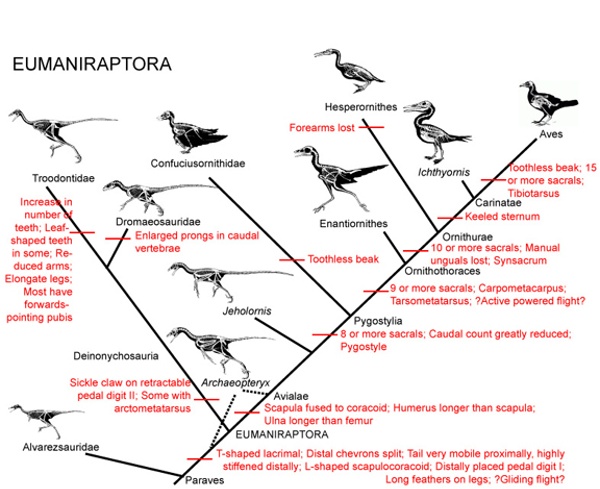
How Dinosaurs Shrank and Became Birds From Quanta Magazine (find original story here). Modern birds descended from a group of two-legged dinosaurs known as theropods, whose members include the towering Tyrannosaurus rex and the smaller velociraptors. The theropods most closely related to avians generally weighed between 100 and 500 pounds — giants compared to most modern birds — and they had large snouts, big teeth, and not much between the ears. For decades, paleontologists’ only fossil link between birds and dinosaurs was archaeopteryx, a hybrid creature with feathered wings but with the teeth and long bony tail of a dinosaur. To explain this miraculous metamorphosis, scientists evoked a theory often referred to as “hopeful monsters.” But it has become increasingly clear that the story of how dinosaurs begat birds is much more subtle. A Phantom Leap In the 1990s, an influx of new dinosaur fossils from China revealed a feathery surprise. Yet once those avian features were in place, birds took off.