

What should students learn in the 21st century? By Charles FadelFounder & chairman, Center for Curriculum Redesign Vice-chair of the Education committee of the Business and Industry Advisory Committee (BIAC) to the Organization for Economic Co-operation and Development (OECD)Visiting scholar, Harvard GSE, MIT ESG/IAP and Wharton/Penn CLO It has become clear that teaching skills requires answering “What should students learn in the 21st century?” on a deep and broad basis. Teachers need to have the time and flexibility to develop knowledge, skills, and character, while also considering the meta-layer/fourth dimension that includes learning how to learn, interdisciplinarity, and personalisation. Adapting to 21st century needs means revisiting each dimension and how they interact: Knowledge - relevance required: Students’ lack of motivation, and often disengagement, reflects the inability of education systems to connect content to real-world experience.
Whole-School Project Builds Pride In rural Howe, Oklahoma, home to about 700 people, the school has long been the heart of the community. Students from pre-K through high school all congregate on the same campus. Now, thanks to the creative efforts of high school students and their teachers, the campus will be getting a facelift that should make local pride shine even brighter. Project Lion Pride was a schoolwide immersion in project-based learning that engaged every student and teacher at Howe High during 10 weeks this spring. Although most students were new to PBL, they stepped up to the challenge of answering this highly relevant driving question: How can we make our school better? On the line was an offer of $1,000 to implement the top idea presented to a panel of judges. Behind the scenes, the entire staff of 13 teachers invested months of preparation to make the project a success. Howe Public Schools is already a 1:1 laptop district that integrates technology effectively. #1. #2. #3. #4. #5.
20 Must-See Facts About The 21st Century Classroom The Current State Of Technology In K-12 7.62K Views 0 Likes What is the next device most students will soon purchase? How many schools have a digital strategy? Find out in the current state of technology in K-12. Introducing the Inquiry Hub Hello & welcome! ... The Digital Education Revolution, Cont'd: Meet TED-Ed's New Online Learning Platform - Megan Garber - Technology TED's new tool lets teachers create customized lessons that revolve around web video. The iconic image of high school education, forged for most of us through personal experience and viewings of Dead Poets Society, is this: a teacher, standing in front of his or her class, lecturing. There are exceptions, definitely: the class discussion, the interactive lab experiment, the game, the field trip. For the most part, though, despite years of education reform, we tend of think of education as a highly vertical experience, one of active teachers and passive students, one in which knowledge radiates out from a single speaker to a roomful of silent listeners. That model is changing, though, and quickly. Today, it's going a step further: TED-Ed is launching a suite of tools that allow teachers to design their own web-assisted curricula, complete with videos, comprehension-testing questions, and conversational tools. That's big. Video, unsurprisingly, is an important component of that toolbox.
www.inquiryhub.org 7th Graders Publish Their Own Textbook Mac Life wrote an article titled Super 7th Graders Publish Their Own eBook to the iBookstore. It explains the project in more detail. "Each student has to choose an organisms they wanted to study and were required to submit their topic for approval. Afterward, students had to write informative – but entertaining! – articles about their organism." Andrea collected work from 69 students and entered it into iBooks Author. iBooks Author is free but only works on Macs running 10.7 Lion or higher. iBooks Author is a fantastically powerful tool. There are some disadvantages to using iBooks author for crafting your own learning materials. Check out what Andrea and her students say about writing their book. I think the comment by CNEBBY in the Customer Reviews of Creatures, Plants and More sums up the project well: "This is an awesome example of what kids can do when they are properly motivated by a skilled teacher."
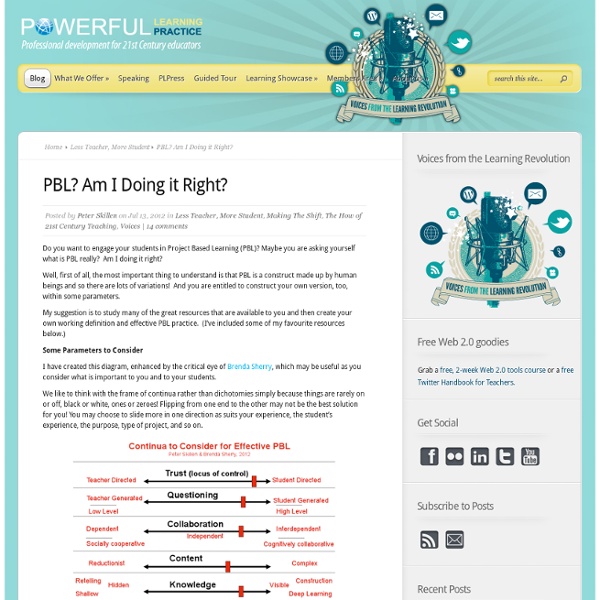
What’s the Best Way to Practice Project Based Learning? By Peter Skillen Project Based Learning can mean different things to different people, and can be practiced in a variety of ways. For educators who want to dive in, the good news is that a rich trove of resources are available. In order to create your own definition and practice, here are some parameters to consider. This diagram, enhanced by the critical eye of Brenda Sherry, can help you figure out what’s important to you and your students. We like to think with the frame of continua rather than dichotomies simply because things are rarely on or off, black or white, ones or zeroes. You could likely add other dimensions to consider as you build your own understandings and beliefs. Who is in control? Who is asking the question to be investigated in the project? If the projects are collaborative in nature, you may wish to consider the amount of interdependence that students have with one another. Is the content a rich, deep problem space or is it a more narrowly focused content area?
The Socratic Method The Socratic Method:Teaching by Asking Instead of by Tellingby Rick Garlikov The following is a transcript of a teaching experiment, using the Socratic method, with a regular third grade class in a suburban elementary school. I present my perspective and views on the session, and on the Socratic method as a teaching tool, following the transcript. The experiment was to see whether I could teach these students binary arithmetic (arithmetic using only two numbers, 0 and 1) only by asking them questions. I had one prior relationship with this class. When I got to the classroom for the binary math experiment, students were giving reports on famous people and were dressed up like the people they were describing. "But what I am really here for today is to try an experiment with you. 1) "How many is this?" 2) "Who can write that on the board?" 3) Who can write ten another way? 4) Another way? 5) Another way? 2 x 5 [inspired by the last idea] 7) One more? X [Roman numeral] 14) Which, nine or ten?
What is PBL? To help teachers do PBL well, we created a comprehensive, research-based model for PBL — a "gold standard" to help teachers, schools, and organizations to measure, calibrate, and improve their practice. In Gold Standard PBL, projects are focused on student learning goals and include Essential Project Design Elements: Resources and Tools for PBL Start to Finish Tips for downloading: PDF files can be viewed on a wide variety of platforms -- both as a browser plug-in or a stand-alone application -- with Adobe's free Acrobat Reader program. Click here to download the latest version of Adobe Reader. Documents to Help You Get Started The Hunger Games Project Documents Below are sample project-based learning documents from teachers Mary Mobley (English) and Michael Chambers (world history) of Manor New Technology High School in Manor, Texas. Back to Top Culture at Manor New Tech High School Manor Visitors Summary Sheet An overview of Manor New Tech for visitors, including mission statement, learning outcomes, and the school's commitments to their students Learning Outcomes Manor New Tech's learning outcomes for all classes Manor Bell Schedule Daily bell schedule for Manor New Tech Additional Resources on the Web Suggested Reading