

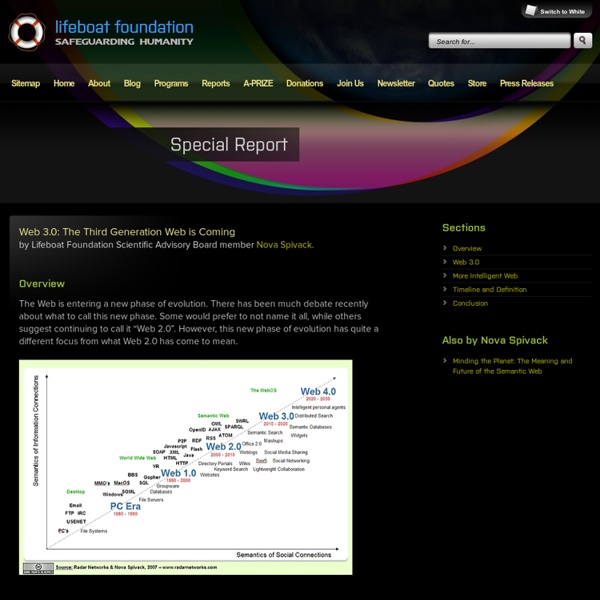
Welcome to Knoesis | Kno.e.sis New Version of My "Metaweb" Graph -- The Future of the Net Notes: Many people have requested this graph and so I am posting my latest version of it. The Metaweb is the coming "intelligent Web" that is evolving from the convergence of the Web, Social Software and the Semantic Web. The Metaweb is starting to emerge as we shift from a Web focused on information to a Web focused on relationships between things --- what I call "The Relationship Web" or the "Relationship Revolution." We see early signs of this shift to a Web of relationships in the sudden growth of social networking systems. This is similar to the human brain -- individual neurons are not particularly important or effective on their own, rather it is the vast networks of relationships that connect them that encode knowledge and ultimately enable intelligence. As the intelligence with which such processes unfolds, in a totally decentralized and grassroots manner, we will begin to see signs of emergent "transhuman" intelligences on the network.
Semantic Web: Technolgies and Applications for Real-World The New Social Media Landscape: A Roadmap July 20th, 2011 It may look like Google+ is competing with Facebook and Twitter, but I don’t think that is what will happen in the end. I think Google+ is a very different kind of service and it’s not clear that it can or will, or should, replace these other services. In a series of articles here on my blog, I’ve explained the differences between these services, and what Google+ is really for and what it means for the rest of the social media giants: The conclusion I draw from all this is that instead of one social network to rule them all, I think it’s more likely that the social media landscape is going to divide into different territories, with each of the major social networks playing a different role. Here’s how I think this all going to shake out: Facebook is for social networkingLinkedIn is for business networkingGoogle+ is for knowledge networkingTwitter is for notifications They just don’t know it yet. Here is some more detail on this idea:
Web 3.0 – Artificial Intelligence? | WebAppRater Representing the Digital Enterprise Research Institute, Liam Ó Móráin , recently discussed the work of the DERI on the Semantic Web and the move from Web 2.0 to Web 3.0. Liam explains how the evolution of Web 2.0 to Web 3.0 (also known as Semantic Web) is taking the web experience to the user in a new and more powerful way. Web 3.0 will quickly and easily combine information from very diverse sources and serve the information to the user, based on intelligent browsing. It is due to the power of the Semantic Web that Google and other search applications serve up, not just what you search for but also related links which are specific to your search history, demographic area and personal browsing preferences. Google and other sites, such as Amazon are able to serve user-specific content within seconds, using the powerful, artificially intelligent brain of Web 3.0. Watch the video and listen to Liam’s speech on Youtube: How does Web 3.0 work? The evolution of Semantic Web Web 1.0 Web 2.0 Web 3.0
Nova Spivack -- Minding the Planet Collective Knowledge Systems: Where the Social Web meets the Semantic Web Collective Knowledge Systems: Where the Social Web meets the Semantic Web [*] Tom Gruber TomGruber.org Summary What can happen if we combine the best ideas from the Social Web and Semantic Web? The Vision of Collective Intelligence The Social Web is represented by a class of web sites and applications in which user participation is the primary driver of value. Collective intelligence is a grand vision, one to which I subscribe. Collective intelligence has been the goal of visionaries throughout the history of the Internet. I would suggest that collective intelligence be taken seriously as a scientific and societal goal, and that the Internet is our best shot at seeing it happen in our lifetimes. Some progress has been made in allowing machines to learn from people and data. With the rise of the Social Web, we now have millions of humans offering their knowledge online, which means that the information is stored, searchable, and easily shared. Collective Knowledge Systems 1. 2. 3. Figure 1.
Nova Spivack In 1994 he co-founded EarthWeb, Inc., one of the first Internet companies (IPO: 1998), which later spun off Dice.com (IPO: 2007). He founded Lucid Ventures in 2001 and the semantic web venture Radar Networks in 2003.[1] Nova Spivack writes about the future of the Internet and topics concerning search, social media, personalization, information filtering, entrepreneurship, Web technology and Web applications.[5][6] Nova Spivack is the grandson of Peter F. Biography[edit] Early life, education and activities[edit] Nova Spivack was born in Boston and grew up in Watertown, Massachusetts. Spivack writes about the future of the Internet;[6] often the Semantic Web, artificial intelligence and search engine technology.[5] He blogs on Minding the Planet and frequently publishes on other websites. Professional career[edit] In the late 1980s Spivack developed software for Kurzweil Computer Products and later at Thinking Machines. Technology ventures[edit] References[edit] External links[edit]
pierre levy Le renouveau de la logotechnie leibnizienne Depuis plusieurs années, Stephen Wolfram, l’inventeur de Mathematica, poursuit un ambitieux objectif : transformer nos connaissances aujourd’hui exprimées maladroitement de manière linguistique en des représentations algorithmiques, directement traitables par un ordinateur. L’équipe progresse toujours un peu plus dans la construction de cet immense chantier. Le projet de Wolfram s’inscrit dans une longue tradition en intelligence artificielle et dans une tendance technologique forte. La langue algébrique universelle de Leibniz Dans un billet de 2009, Stephan Wolfram présentait l’essence de son projet Wolfram Alpha comme étant précisément une tentative de "rendre la connaissance computable" pour contourner le problème quasiment insoluble de l’analyse du langage naturel. "après avoir fait cela, lorsqu’il surgira des controverses, il n’y aura plus besoin de discussion entre deux philosophes qu’il n’y en a entre deux calculateurs. Calculons !
Nova Spivack: World Renowned; Pioneering Global Technology Visionary, Innovator, Strategist, Entrepreneur, Investor - Top Interview - Social Media for China Business Nova Spivack is a technology futurist, serial Internet entrepreneur, and one of the leading voices on the next-generation of search, social media, and the Web. He works as a producer of emerging technology ventures including Twine.com, Live Matrix, Klout, Bottlenose, The Daily Dot, StreamGlider, and a stealth-mode new energy company. In 1994 Nova co-founded one of the first Web startups, EarthWeb, which led to a record-breaking IPO in 1998, and a second IPO DICE.com in 2007. Nova worked with Stanford Research International (SRI), to conceive and co-found their global business incubator nVention, and on the DARPA CALO program, the most ambitious artificial intelligence project in US history. He is a frequent speaker and blogger, and has written guest-articles for TechCrunch, GigaOM, and SiliconAngle. Nova has authored more than 30 granted and pending patents. Nova is the eldest grandson of the late management guru Peter Drucker. Media & Press Invited Talks
YAGO - D5: Databases and Information Systems (Max-Planck-Institut für Informatik) Overview YAGO is a huge semantic knowledge base, derived from Wikipedia WordNet and GeoNames. Currently, YAGO has knowledge of more than 10 million entities (like persons, organizations, cities, etc.) and contains more than 120 million facts about these entities. YAGO is special in several ways: The accuracy of YAGO has been manually evaluated, proving a confirmed accuracy of 95%. Every relation is annotated with its confidence value.YAGO combines the clean taxonomy of WordNet with the richness of the Wikipedia category system, assigning the entities to more than 350,000 classes.YAGO is an ontology that is anchored in time and space. YAGO is developed jointly with the DBWeb group at Télécom ParisTech University.