

Top 5 Books That Will Change How You Think! | Huge Relief Fast Self education is vastly underrated! I came across this concept back in my early twenties, and got curious. I figured out that there was nothing that was stopping me more from learning apart from me. And the good news is that when you begin to use self-education to your advantage, you learn on your terms. There are many benefits to self education. So, forgive the proselytizing, but I’m a huge advocate of self-education. Over the years, thanks to self-education, I have learn’t how the cosmology of the multi-verse works (from a spiritual standpoint), how the mind operates (from a psychological standpoint) and why the world is like it is (to a certain degree, anyway;-). Below are the top 5 books that can help you make a similar journey, and books that have not only altered my way of thinking, but got me living more from love and peace than ever before. 1. The book that got being present into the mainstream, and brought being mindful to the masses. 2. 3. 4. 5. About the author
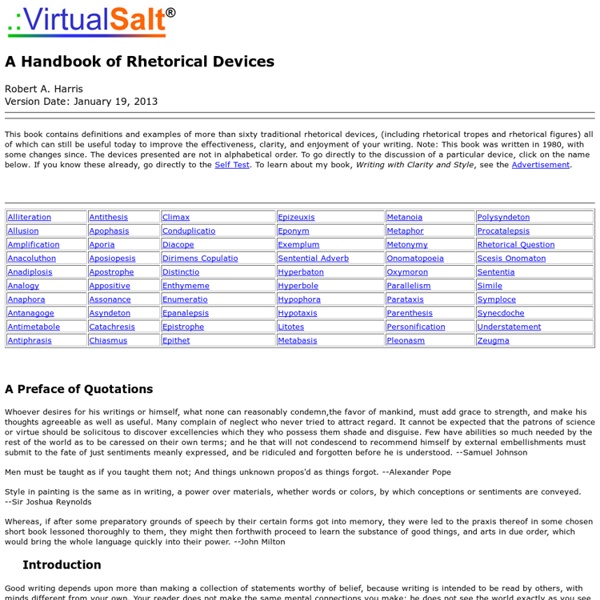
23 Websites that Make Your Writing Stronger We are all apprentices in a craft where no one ever becomes a master. ~Ernest Hemingway How strong is your writing? No matter how good you think it is, there’s always room for improvement. In most cases, plenty of room. Luckily, there are some amazing websites that’ll help you improve your writing, and take it to the next level. (***By the way, have you seen this amazing online creative writing course, “Story Is a State of Mind,” created by Giller finalist Sarah Selecky? Want to strengthen your story, empower your performance, and beef up on the publishing business? Here are 23 sites (in no particular order) I look to for daily inspiration and advice: PS If you find this list useful, please share it on Twitter, Facebook or StumbleUpon – I’d really appreciate it! 4) Query Shark A query critique site you don’t want to miss. 5) Men with Pens Fantastic articles on copywriting and freelancing. 6) Ask Allison Writing and publishing Q&A by novelist Allison Winn Scotch.
Home page | Some paradoxes - an anthology - StumbleUpon Literary technique A literary technique (also known as literary device) is any method an author uses to convey his or her message.[1] This distinguishes them from literary elements, which exist inherently in literature. Literary techniques pertaining to setting[edit] Literary techniques pertaining to plots[edit] Literary techniques pertaining to narrative perspective[edit] Literary techniques pertaining to style[edit] Literary techniques pertaining to theme[edit] Literary techniques pertaining to character[edit] Literary techniques pertaining to genre[edit] Notes[edit] Jump up ^ Orehovec, Barbara (2003). References[edit] Heath, Peter (May 1994), "Reviewed work(s): Story-Telling Techniques in the Arabian Nights by David Pinault", International Journal of Middle East Studies (Cambridge University Press) 26 (2): 358–360
New York Times 50 Most Challenging Words (defined and used) | Currently Obsessed The New York Times recently published a list of 50 fancy words that most frequently stump their readership. They are able to measure this data thanks to a nifty in-page lookup mechanism, which you can try here. Try double-clicking the word “epicenter”. Since the NYT didn’t include definitions of these words, I decided to post a job to MediaPiston to produce an article defining and using each word in the list. Voila! Just a few hours later, here it is. The New York Times 50 Fancy Words (defined and used) 1. 2. 3. 4. 5. 6. 7. 8. 9. 10. 11. 12. 13. 14. 15. 16. 17. 18. 19. 20. 21. 22. 23. 24. 25. 26. 27. 28. 29. 30. 31. 32. 33. 34. 35. 36. 37. 38. 39. 40. 41. 42. 43. 44. 45. 46. 47. 48. 49. 50.
Common Errors in English Use the search form below to find words and phrases on this site. About this Search Engine E e.g. / i.e. each early adapter earmarks / hallmark earth, moon easedrop ecology / environment economic / economical ecstatic ect. A List Of Fallacious Arguments attacking the person instead of attacking his argument. For example, "Von Daniken's books about ancient astronauts are worthless because he is a convicted forger and embezzler." (Which is true, but that's not why they're worthless.) Another example is this syllogism, which alludes to Alan Turing's homosexuality: Turing thinks machines think. (Note the equivocation in the use of the word "lies".)
Why I Write Gangrel, [No. 4, Summer] 1946 George Orwell’s “National Union of Journalists” press card (1943) From a very early age, perhaps the age of five or six, I knew that when I grew up I should be a writer. Between the ages of about seventeen and twenty-four I tried to abandon this idea, but I did so with the consciousness that I was outraging my true nature and that sooner or later I should have to settle down and write books. I was the middle child of three, but there was a gap of five years on either side, and I barely saw my father before I was eight. However, throughout this time I did in a sense engage in literary activities. When I was about sixteen I suddenly discovered the joy of mere words, i.e. the sounds and associations of words. So hee with difficulty and labour hard Moved on: with difficulty and labour hee. which do not now seem to me so very wonderful, sent shivers down my backbone; and the spelling ‘hee’ for ‘he’ was an added pleasure. (i) Sheer egoism. (iii) Historical impulse.
Liberalism is socialism, and socialism is big government Myth: Liberalism is socialism, and socialism is big government. Fact: Liberals believe in private ownership of the means of production; socialists, public. Summary Modern American liberals are democratic capitalists. Argument One of the main features of the Great American Debate is the perversion of basic political terms. LiberalismProgressivismSocialismSocial DemocracyAnarcho-socialismAnarcho-syndicalismMutualist anarchismSocial anarchismCommunismMarxismStalinism This list may confuse some readers who have inadvertently accepted the far right's revisionism; after all, isn't the term "anarcho-socialism" an oxymoron? Who owns the means of production? One of the central questions of any political ideology is "Who should own and control the means the production?" Socialism has been proposed in many forms. This point is probably the most confused and misunderstood aspect of socialism. Socialism may always be democratic, but what type of socialism depends on what type of democracy is practiced.
List of fallacies A fallacy is incorrect argument in logic and rhetoric resulting in a lack of validity, or more generally, a lack of soundness. Fallacies are either formal fallacies or informal fallacies. Formal fallacies[edit] Main article: Formal fallacy Appeal to probability – is a statement that takes something for granted because it would probably be the case (or might be the case).[2][3]Argument from fallacy – assumes that if an argument for some conclusion is fallacious, then the conclusion is false.Base rate fallacy – making a probability judgment based on conditional probabilities, without taking into account the effect of prior probabilities.[5]Conjunction fallacy – assumption that an outcome simultaneously satisfying multiple conditions is more probable than an outcome satisfying a single one of them.[6]Masked man fallacy (illicit substitution of identicals) – the substitution of identical designators in a true statement can lead to a false one. Propositional fallacies[edit]
Showing Character Change by Joy Cagil As has been indicated by writers and writing coaches, in a good story, characters create conflict; consequently, conflict creates drama. In addition, a story shows more depth if its characters go through changes. The question is: how can a writer go about showing the changes inside his characters during the trajectory of the story? Let us take a brief look at how some characters may go through a change in a story. The change can also be shown through the interaction of characters called confidantes. If a major character has his opposite, at the end of the story when that character has gone through a change, the reader finds that the character's understanding and values has neared to that of his opposite. The most important fact is that all character changes in a story must come through the events in a story. Some character changes come about slowly throughout the story; others happen instantly as the result of one dramatic event. About the Author